

Why a property investment for passive income now?
If you have already put aside several tens of thousands of euros, you are probably wondering whether it would be more advantageous to buy a home to rent out instead of keeping the money only in your account or in government bonds. The current context in Romania encourages such questions. Banca Națională a României shows in the 2024 Financial Stability Report that the residential market is facing an imbalance between demand and supply, with declines in building permits and new homes delivered, while demand remains high. This context tends to support housing prices in the medium term.
At the same time, Ministerul Finanțelor issued in 2024 government bonds intended for the population with interest rates of around 6-7% per year for maturities between 1 and 5 years, which creates a clear benchmark: any property investment for passive income should be analysed in relation to this relatively safe yield, guaranteed by the state.
In large cities, a property investment started intelligently can generate, after costs, a net yield close to or even above the interest on government bonds, but with higher risk and management effort.
Therefore, the key to your first property investment is not necessarily to "catch the opportunity of a lifetime", but to build a clear process: what you want to buy, with what money, with what target yield and with what risks you are comfortable.
Step 1: What type of property do you want to buy?
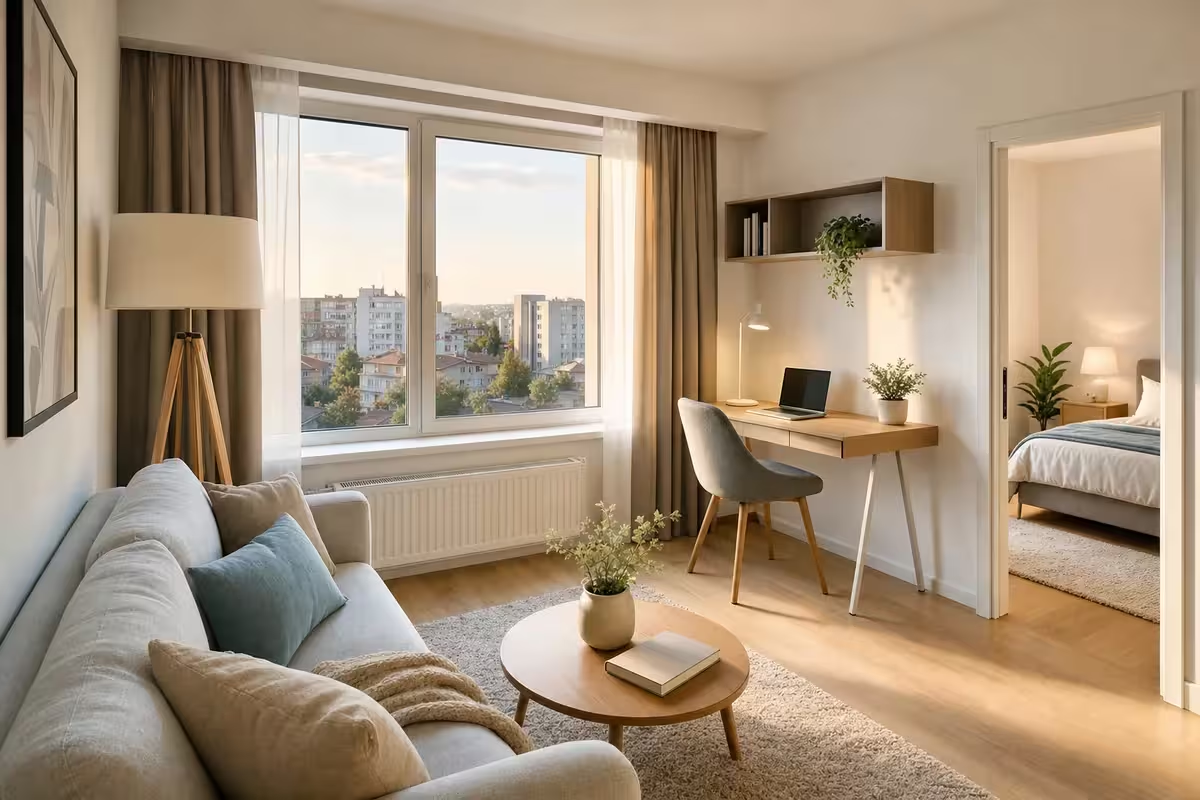
The first step is to define as precisely as possible the type of property, because both the possible monthly income and the level of risk and the degree of involvement required depend on it. In practice, for an investor making a first purchase, the most frequent options are:
- Studio or one-room apartment in a large city, long-term rental;
- Two-room apartment, close to transport and office centres;
- Larger apartment (3 rooms or more), for families, with more stable contracts but higher initial investment;
- Properties for short-term rental (hotel-type), which can bring higher gross income but involve more time, regulations and occupancy risks.
Statistically, in București, a two-room apartment was rented on average in 2024 for approximately 520 euros per month, according to a Digi24 analysis based on market data, while a studio reached around 350 euros per month. Similar, adjusted rent levels can also be found in other major university centres, confirming that rental demand remains sustained in large urban areas.
Before any viewing, clearly write down your desired profile: type of apartment, city, neighbourhood, purchase budget, renovation budget and the minimum monthly rent you are targeting. This personal brief will filter out 80% of the listings that are not suitable for you.
Step 2: Calculate the yield and compare it with safe alternatives
A property investment for passive income must be treated as a small business, with income and expenses, not just as "an apartment to keep for the children". Therefore, the expected annual yield must be calculated and compared with safe alternatives, especially government bonds.
In 2024, Ministerul Finanțelor issued FIDELIS government bonds in lei with fixed coupons of approximately 6.85% per year for the 2027 maturity, and on the TEZAUR segment interest rates were around 6-7% per year for maturities of 1-5 years, according to the ministry's official documents and press releases. These yields are net of bank fees and guaranteed by the state, representing the benchmark of "almost worry-free passive income".
In real estate, the gross annual yield is calculated simply: average monthly rent × 12 months, divided by the total purchase price (including taxes and renovation). For example, if you pay 90,000 euros for a two-room apartment and rent it out for 520 euros/month, the gross yield is approximately 6.9% per year. From this percentage you have to subtract income tax, possible months without a tenant, repairs and other costs, which reduces the net yield.
- A gross yield close to 7-8% can be competitive compared to government bonds, especially if you accept long-term property value volatility;
- A gross yield below 5-6% brings you closer to a defensive investment scenario, in which you rely more on the appreciation of the property price than on monthly income.
It is important to also refer to market data on sale prices. The Imobiliare.ro Index shows the evolution of average prices at national and city level and is used, including by BNR and the authorities, in analyses of the Noua Casă programme, which validates it as a benchmark for transaction price trends. Even if it does not value your property exactly, it shows you the trend: if the yield from rent falls below the rate of government bonds, the interest of purely financial investors tends to decrease.
Step 3: Location, infrastructure and tenant profile
The choice of property type goes hand in hand with the choice of location and the profile of the tenant you are targeting. BNR emphasises in its financial stability reports that demand remains high in major urban centres, where well-paid jobs and universities are concentrated. For an investor making a first purchase, this translates into a few simple rules:
- Choose neighbourhoods with good access to public transport and main roads;
- Look at the distance to office clusters, universities or hospitals;
- Analyse supply and demand through active listings and the history of rents in the area;
- Check the urban planning regime and the announced infrastructure projects (metro, road widening), which can influence long-term attractiveness.
A well-located two-room apartment will attract young professionals, couples and expats alike, reducing the risk of long vacancy periods. You can also adjust your furnishing strategy: full, modern furnishing increases attractiveness and allows you to charge a somewhat higher rent, but involves initial investment and wear and tear.
Before signing any preliminary contract, draw up a cash-flow plan: how much money comes in monthly from rent, how much goes out on tax, maintenance costs not paid by the tenant, repair fund, insurance and a reserve fund for possible months without a tenant.
Step 4: Financing, risk and investor discipline
If you are not buying exclusively from savings but need a mortgage loan, your analysis must also include the cost of financing. BNR's financial stability reports warn that the high level of interest rates and indebtedness can become a risk in periods of uncertainty. In other words, do not rely on the idea that "interest rates will surely fall" when you calculate the feasibility of the investment.
Calculate the monthly loan instalment in a conservative scenario, not only at the initial promotional interest rate. Make sure that:
- The rent covers the instalment and current costs, leaving a safety buffer;
- You have financial reserves for at least 6 months of instalments, in case you lose the tenant or face major repairs;
- You do not exceed a level of indebtedness that would make you vulnerable to a decrease in your main income.
Compare this scenario with the alternative of placing part of the money in government bonds, which offer you predictable passive income, without the worry of tenants and without the low-liquidity risk associated with properties. Ziarul Bursa highlighted in a dedicated analysis that in recent years interest rates on government bonds have become increasingly attractive compared to mortgage loans, which changes the balance between investments in public debt and those in real estate. For you, as a small investor, the conclusion is clear: property must beat or at least match, in net yield, a balanced portfolio of government bonds, otherwise the additional effort and risks may not be worthwhile.
Investor discipline also means not falling in love with a property just because "you like how it looks". Always ask for a utilities history, check the cadastral and legal situation with ANCPI, ask the owners' association about any disputes or debts and factor in the costs of bringing the property up to rental standard.
Step 5: Exit strategy and time horizon
In the end, any property investment must be designed with an exit strategy. The property market is less liquid than the market for government bonds or other financial instruments. BNR shows in its reports that future housing price developments depend on macroeconomic factors, the cost of financing and the level of household income. It is not realistic to start from the premise that "prices always rise".
Define from the very beginning:
- The time horizon: do you want to keep the property for 5, 10 or 20 years;
- The minimum yield threshold at which you would sell and reinvest in something else;
- The scenarios in which you would turn the home from an investment into your own living space or into support for your children.
A successful property investment for passive income combines three things: acceptable yield compared to safe alternatives, controlled risk through responsible financing and a clear long-term plan. If you do your homework, use official data and treat the purchase as a business, not just as "an extra apartment", your chances of turning the money put aside into a constant flow of rent month after month increase significantly.
Sources
- Banca Națională a României – Rapoarte asupra stabilității financiare 2024–2026, secțiunile privind piața imobiliară rezidențială
- Imobiliare.ro – Indicele Imobiliare.ro și rapoartele Market 360 privind evoluția pieței rezidențiale
- Ministerul Finanțelor – Prospecte și ordine privind emisiunile de titluri de stat TEZAUR și FIDELIS în 2024
- Digi24 – Analiză privind evoluția chiriilor în marile orașe din România în 2024
- Ziarul Bursa – Analize privind randamentele titlurilor de stat și creditele ipotecare în România
Întrebări frecvente
Ce randament minim ar trebui să urmăresc la prima investiție imobiliară?
For a property investment focused on passive income, it is reasonable to aim for a gross yield of at least 6-7% per year, so that the net yield, after taxes and expenses, is comparable to or slightly higher than that offered by government bonds issued by Ministerul Finanțelor. The exact threshold depends on your risk appetite and how much you get involved in management.
Ce este mai avantajos pentru venit pasiv: apartament de închiriat sau titluri de stat?
Government bonds provide more predictable passive income, guaranteed by the state and without the burden of management, while a rented apartment can bring a higher yield but with additional risks (vacancy, repairs, price fluctuations) and management time. For a cautious beginner, a combination of the two can be a balanced solution.
Ce tip de proprietate este mai potrivită pentru prima investiție imobiliară?
As a rule, a studio or a two-room apartment in a large city, close to transport and employment centres, is the most balanced option for a first investment. Such properties have strong rental demand, are easier to furnish and manage, and involve a more accessible purchase budget than large apartments or special-purpose properties.