

What “rent cost” really means in 2026
When you look at a rental listing, the first thing you see is the monthly rent. In reality, the budget you need to prepare at the start of the contract and throughout its duration is much higher. In 2026, in the context of still elevated inflation and rising living costs, careful planning of these expenses is no longer a luxury, but a necessity.
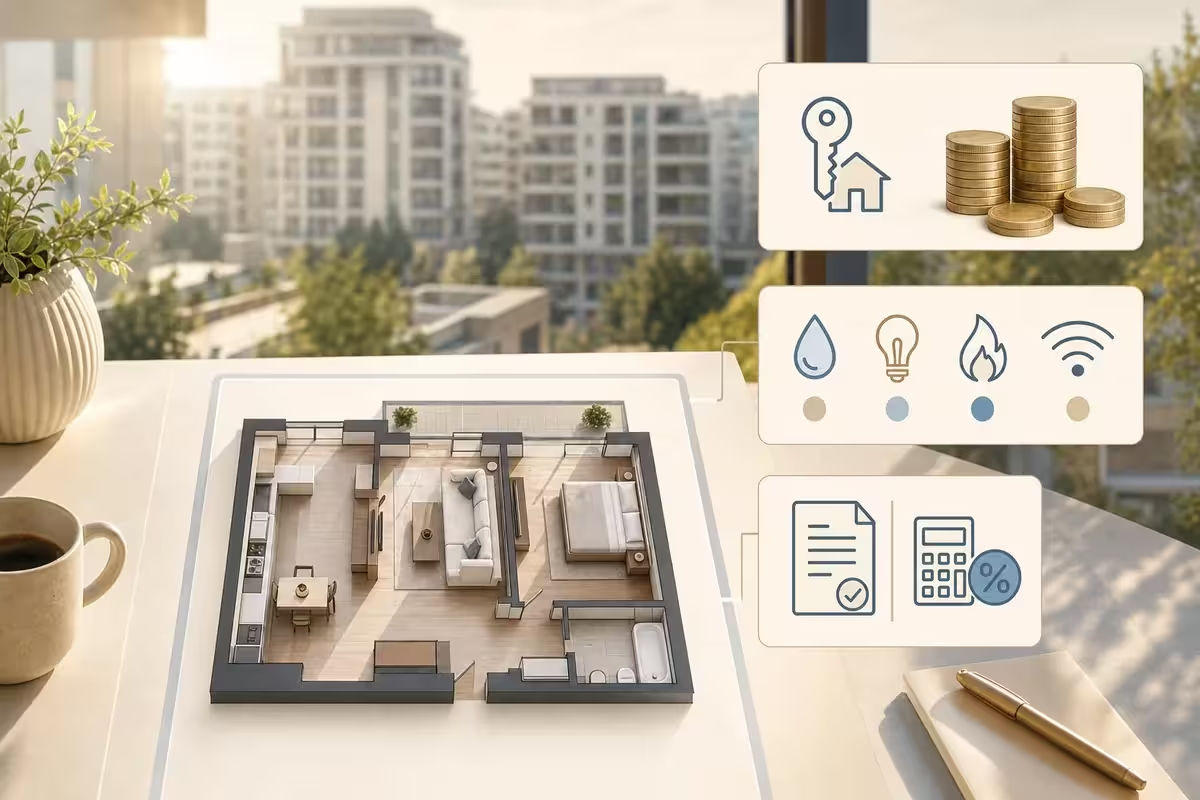
In addition to the base rent, you will have to pay a security deposit, possibly an agency commission, utilities, building maintenance and taxes to the state, depending on your situation (landlord or tenant). On top of that, you must take into account the overall evolution of prices for goods and services, which indirectly affects your housing budget.
When you draft your relocation budget, bear in mind that, in the first month, you may end up paying the equivalent of 3–4 monthly rents combined, including the security deposit, commission and estimated utilities.
Base rent and how prices have evolved
The monthly rent is the amount stated in the contract for using the dwelling. At an aggregate level, Institutul Național de Statistică includes rent in the consumer price index, under the group “Housing, water, electricity, gas and other fuels”. Data from INS, also aggregated in the statistics of Banca Națională a României, show that in recent years this category has contributed significantly to overall inflation, although in the electricity and gas segment there were temporary decreases due to price caps.(bnr.ro)
At the same time, INS reported in 2026 a sharp increase in the index for the “Rent” group in official statistics, mainly as an effect of changes to the monthly tariffs charged for homes from the public housing stock, through a government decision that raised rent levels for dwellings owned by the state and local authorities.(economica.net) This change does not mean that all rents in the private market instantly increased by the same percentage, but it does put upward pressure on the general level of rents, especially in large cities.
In market practice, landlords adjust prices based on supply, demand and costs. A factor to monitor is the overall evolution of inflation, published quarterly by BNR and monthly by INS. If inflation remains at a relatively high level, it is prudent to allow for a 5–10% margin in your annual budget for potential renegotiations or moves.
The security deposit: how much is blocked and for how long
The security deposit is the amount that the landlord withholds at the start of the contract as protection against potential damage or arrears. Legislation does not set an explicit cap on the number of months for the deposit, but in practice, on the standard residential market, the usual requirement is the equivalent of one month’s rent, and sometimes two months for premium furnished homes or for tenants with no rental history.
The deposit is not a consumed cost, but blocked capital. However, from a cash flow perspective, you should treat it as an initial cost: if the rent is 500 euros, a one-month deposit means another 500 euros that you must have available at signing. In addition, in case of dispute or damage, recovering the full deposit can be difficult, so part of the amount may effectively turn into a cost.
Landlords should bear in mind that, as the market becomes more professional and ANAF pays closer attention to rental income, clear documentation of the dwelling’s condition at handover and return (handover reports, photos) becomes essential for justifying any deductions from the deposit.
The real estate agency commission and how to negotiate it
Although it is not regulated by a special law, the commission charged by real estate agencies has become standard practice in the market. Many agencies charge a commission proportional to the monthly rent, differing for tenants and landlords depending on the services provided. Some large agencies in București, for example, promote a working model in which initial costs are zero for the landlord, with the commission collected at the transaction, at a level displayed transparently on the website.(vib.ro)
In practice, in the residential segment, the commission level is usually between 50% and 100% of one month’s rent for the tenant or the landlord, depending on who contracts the service. The exact structure of the commission, who pays it and when it is paid must be detailed in the intermediation contract or the agency’s service contract.
If you are a tenant, include the commission in your initial budget. For example, for a rent of 500 euros, a 50% commission means an additional 250 euros, while a 100% commission adds another full month’s rent in the first month. If you are a landlord, check what services are included: professional marketing, tenant screening and verification, assistance at contract signing, subsequent management of the relationship with the tenant. A higher commission can be justified if it saves you time and reduces the risk of non-payment or damage.
Utilities, building maintenance and other monthly expenses
In addition to the base rent, you must include in your budget the costs of utilities and building maintenance: electricity, natural gas or district heating, water, sewage, waste collection, building management services, as well as optional services such as internet and TV.
BNR bulletins and reports, based on INS data, show that electricity and gas prices have been volatile in recent years, with sharp increases in 2021–2022, followed by temporary decreases due to government interventions and price caps, which even led to negative annual dynamics in this segment at the end of 2023.(bursa.ro) However, in the medium term, both BNR and independent analyses point out that the gradual liberalisation of the energy market may bring renewed pressure on bills.(bns.ro)
In this context, it is prudent for a tenant to estimate a monthly utilities budget with a safety margin of 10–20% above the average of recent months, especially in the cold season. Landlords who rent out homes on an “all-inclusive rent with utilities” basis must take these risks into account when setting the price, to avoid situations where the rent collected no longer covers the costs.
- Electricity, gas or district heating: varies seasonally, with peaks in winter.
- Water, sewage, waste collection: set by local operators’ tariffs, updated periodically.
- Building maintenance and common charges: revolving fund, repairs, common services, set by the homeowners’ association.
- Internet and telecom services: standard packages, usually contracted directly by the tenant.
In large cities, it is not unusual for the total of utilities and building maintenance to reach 30–50% of the rent value in winter months, depending on the type of building, insulation and consumption.
Taxes and obligations to the state: what landlords and tenants need to know
Starting in 2024, ANAF launched a guide dedicated to individuals who obtain income from renting movable and immovable property, explaining tax obligations regarding income tax and the social health insurance contribution (CASS), the methods of declaration and payment, as well as the applicable legal framework.(agerpres.ro)
In short, the landlord is the one who owes income tax on rent and, where applicable, CASS, depending on the total level of non-salary income. Rental income falls under “income from the transfer of the use of property”, and current rules provide for tax on net income, calculated after applying a standard deductible cost rate, with a tax rate of 10%.(legislatie.just.ro) For high incomes that exceed the annual threshold set according to the minimum wage, CASS is also due, in line with the fiscal legislation in force and ANAF guidelines.
The tenant does not pay taxes directly to ANAF for a classic registered rental, but has an interest in the landlord fulfilling tax obligations. A registered contract and correctly declared income provide greater legal security for both parties, including when bank support, residence visa or rent reimbursement is needed (for example, for relocated employees).
For landlords, failing to declare rental income may incur penalties and interest, and in serious cases falls under tax evasion, as results from the general framework of tax legislation and the references of the Ministry of Finance regarding combating evasion.
Conclusion: how to build a realistic rent budget
In 2026, the real cost of living in a rented home is the result of a combination of amounts: base rent, security deposit, agency commission, utilities and building maintenance, plus, for landlords, taxes owed to the state. The overall evolution of inflation and energy prices can significantly change this picture over the course of the contract.
As a tenant, start from the base rent, add at least one month’s deposit and any agency commission, then carefully estimate utilities, with a safety margin. As a landlord, calculate net income after tax and CASS where applicable, bearing in mind that any increase in utility costs can put pressure on the relationship with the tenant, especially if you have agreed on rent with utilities included.
Regardless of your role, constantly follow public data from INS, BNR and ANAF. These provide the macroeconomic context you need to understand why rents are rising, how utility costs are evolving and what tax obligations you have, so you can make informed decisions and avoid unpleasant surprises.
Sources
- Institutul Național de Statistică – baze de date TEMPO, indicii prețurilor de consum
- Banca Națională a României – Rapoarte asupra inflației și buletine lunare
- BNR – Raport anual 2023 și analize privind prețurile la energie
- AGERPRES – comunicat ANAF privind ghidul pentru veniturile din închirieri, aprilie 2024
- Economica.net – explicațiile INS privind creșterea indicelui pentru grupa „Chirie”, 2026
- VIB Imobiliare – prezentare servicii și model de comision pentru proprietari
- Portal Legislativ – legislație fiscală relevantă pentru veniturile din chirii
Întrebări frecvente
Ce sumă trebuie să pregătesc la semnarea unui contract de închiriere?
Generally, at least the first month’s rent, one month’s deposit and, if you work with an agency, a commission that can reach the value of one month’s rent. Overall, budget for 3–4 monthly rents combined to cover all initial costs.
Cine plătește impozitul pe chirie în România?
The income tax on rent is paid by the landlord, based on the rental contract and the tax rules applicable to income from the transfer of the use of property. The tenant does not owe tax directly to ANAF, but has an interest in the income being correctly declared, for legal security.
Cum pot estima corect costul utilităților când închiriez un apartament?
Ask the landlord for the latest utility bills, look at how they evolved over a full year and add a safety margin of 10–20%, taking into account INS and BNR reports on inflation and energy costs. This way you reduce the risk of underestimating the real monthly costs.