

Student life, between the desire for independence and budget reality
Transitioning to student life means more than choosing a faculty. For many young people, it means moving to another city and taking on, for the first time, a real monthly budget: rent, food, transport, utilities, and social activities. In a context where monthly consumption expenditures of households in Romania have reached, on average, approximately 3,000 lei per person in urban areas, according to INS data for the fourth quarter of 2023, careful planning becomes essential for a student.
Below, we estimate a reasonable budget for student life in rental housing, in the main university centers, using the most recent data available on rents and the structure of consumption expenditures.
Rent, the main cost of student life
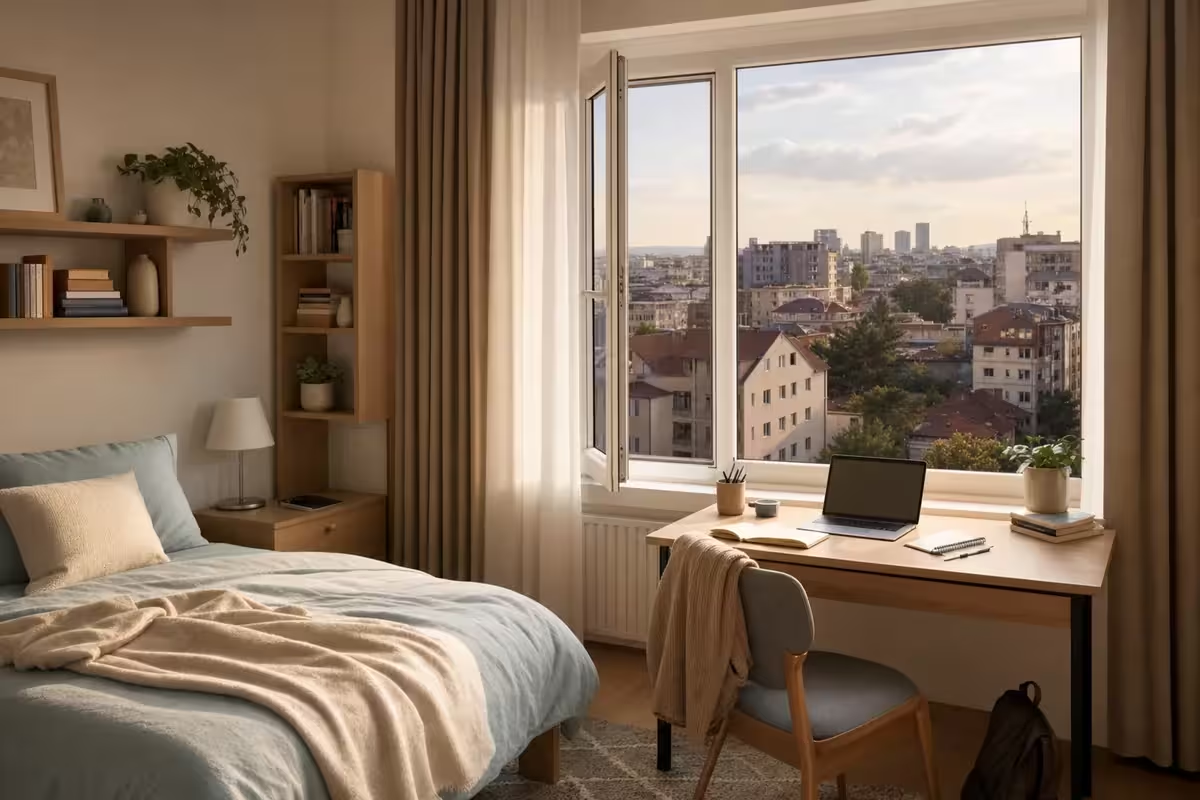
Rent is by far the largest component of the budget for a student who does not get a dorm place. According to a Storia analysis cited by Agerpres for 2024, the average asking price for a studio apartment at national level reached 324 euros per month, up by approximately 13% compared to 2023. In the major university centers, prices are significantly higher.
In 2024, the same analysis shows that:
- in Cluj-Napoca, the average asking rent at apartment level is 585 euros per month;
- in București, the average rent is 565 euros per month;
- in Iași, the average rent is 427 euros per month;
- in Timișoara, the average rent is 405 euros per month.
Another Storia study, also published via Agerpres, details that, for studios, in autumn 2024 average rents were approximately 420 euros in Cluj-Napoca and 300 euros in Timișoara, with an increase of about 5-7% compared to the previous year. These values are relevant for students looking for small homes, close to the faculty.
For a student renting a studio, a realistic rent budget starts at approximately 300 euros per month in Timișoara or similar cities and goes up to 400-450 euros in Cluj-Napoca, depending on location and amenities.
In practice, many students share a two-room apartment, where the national average rent reached approximately 493 euros per month in 2024. Split in two, the individual cost can fall below the level of a studio, especially in București and Iași. For a balanced budget, it is worth considering co-living, especially in cities with high pressure on the rental market, such as Cluj-Napoca.
Food and everyday expenses
After rent, food is the main expense category. Data published by INS and summarized by Agerpres show that, in the fourth quarter of 2023, expenditures on food and non-alcoholic beverages represent, on average, over 30% of total household consumption expenditures, while housing, water, electricity, and gas account for approximately 15%.
Translated to the level of an individual in an urban area, with spending of approximately 3,000 lei per month, this results in an average budget of around 900-1,000 lei for food. For a cost-conscious student who eats daily in the canteen or cooks at home, a realistic range is as follows:
- 700-900 lei per month, for a regime based on cooking at home and supermarket deals;
- 900-1,100 lei per month, if more frequent meals out or food deliveries are included.
It is important to note that food inflation has remained a relevant component of the general increase in prices, according to BNR reports from 2024, so a 10-15% buffer above the minimum estimate is prudent.
Transport, from significant cost to almost free
An important advantage of student life in Romania is the facilities for public transport. According to the official platform Studiază în România, in 2025 and 2026 full-time enrolled students benefit from a 90% reduced fare on local public transport and metro, in the locality where the university is located. In practice, universities reimburse 90% of the subscription cost, and in some centers even 100%, depending on agreements with local authorities.
Universities in Iași are a clear example. Universitatea „Alexandru Ioan Cuza” and Universitatea Tehnică „Gheorghe Asachi” specify that students can purchase transport passes at full price, with 90% or even 100% of the cost to be reimbursed later, based on supporting documents. Procedures are detailed in internal regulations, but the budget impact for the student is very small.
In București, Societatea de Transport București mentions full facilities for school pupils, and similar discount schemes apply for students, in line with national legislation. For intercity transport, the Methodological Norms of the Ministry of Education, correlated with higher education legislation, maintain substantial reductions on train travel, generally 50% or more, for Romanian students.
In practical terms, a student who travels daily in the university city may end up paying effectively only a few dozen lei per month for local transport, thanks to the reimbursement of 90-100% of the pass. Transport between the home city and the university city, usually by train, remains an additional expense, but is considerably reduced by the existing facilities.
Utilities and other expenses: how much you add to the budget
For students living in rented accommodation, utilities are usually paid separately: electricity, gas, water, internet, and possibly building maintenance. The structure of urban household expenditures published by INS indicates an average level of approximately 600 lei per month per household for housing, water, electricity, and gas. For a small apartment or studio occupied by one or two students, the actual amount paid by a single person will depend on the season and the number of flatmates.
A prudent scenario for a student might look like this:
- basic utilities (electricity, gas, water, maintenance) 300-400 lei per month, shared between two flatmates;
- internet and possibly TV 50-80 lei per month, also shared between two;
- personal expenses (mobile phone, digital subscriptions, clothing, hygiene) 200-300 lei per month.
Compared to the official structure of household expenditures, where transport has a share of approximately 7% and clothing and footwear around 8%, these values are in line with national averages, adjusted to the lifestyle of a young person.
How much a month of student life in rental housing costs in total
Based on the above data, we can outline an indicative monthly budget for a student living in rented accommodation, without significant own income, in some of the most important university cities:
- București
Rent for a studio or half of an apartment: 300-350 euros (around 1,500-1,750 lei, depending on the exchange rate).
Food: 800-1,000 lei.
Utilities and internet (own share): 250-350 lei.
Local transport, after reimbursement: 30-70 lei.
Indicative total budget: 2,600-3,100 lei per month. - Cluj-Napoca
Rent for a studio: approximately 400-450 euros (2,000-2,250 lei), or less if a two-room apartment is shared.
Food: 800-1,000 lei.
Utilities and internet: 250-350 lei.
Local transport, after reimbursement: 30-70 lei.
Indicative total budget: 3,100-3,700 lei per month, with the possibility of significantly reducing it through co-living. - Iași
Rent for a studio: approximately 300-350 euros (1,500-1,750 lei), in line with the 427-euro average for apartments, if we are talking about small homes and areas close to campus.
Food: 700-900 lei.
Utilities and internet: 250-350 lei.
Local transport, after 90-100% reimbursement: 20-60 lei.
Indicative total budget: 2,400-2,900 lei per month. - Timișoara
Rent for a studio: approximately 300 euros (around 1,500 lei), in line with the average reported for studios in 2024.
Food: 700-900 lei.
Utilities and internet: 250-350 lei.
Local transport, with facilities: 30-70 lei.
Indicative total budget: 2,400-2,800 lei per month.
These estimates are aligned both with data on rent levels in major university cities and with the average structure of consumption expenditures published by INS. For families sending their child to university in another city, a realistic monthly budget in 2025 is between 2,400 and 3,700 lei, depending on the city, type of housing, and the student’s lifestyle.
Sources
- Agerpres / Storia – Piața chiriilor în 2024
- Agerpres / Storia – Analiză chirii în orașele universitare
- Agerpres / INS – Veniturile și cheltuielile gospodăriilor, T4 2023
- Studiază în România – Facilități de transport pentru studenți
- Universitatea „Alexandru Ioan Cuza” Iași – Informații transport studenți
- Universitatea Tehnică „Gheorghe Asachi” Iași – Procedură decontare transport local studenți
- STB – Informații facilități pentru tineri
- BNR – Rapoarte asupra inflației 2024
Întrebări frecvente
Care este bugetul minim lunar pentru un student la București, în chirie?
For a student renting accommodation in București, a realistic budget starts at approximately 2,600 lei per month, including shared rent or a cheaper studio, food, utilities, and local transport with student discounts.
De ce este Cluj-Napoca mai scump decât alte orașe universitare?
Market analyses show that very high demand for rental housing, compared to a limited supply, has pushed rents in Cluj-Napoca above those in București, which makes the student budget here the highest.
Cum îmi pot reduce bugetul lunar ca student în chirie?
The most effective solutions are to share an apartment with other colleagues, to take advantage of reimbursed transport passes, to cook at home instead of eating out daily, and to track your monthly spending in order to eliminate small recurring costs that add up.