

Why real estate fraud is increasing and what “safety” means for you
The real estate market is increasingly digitalised, and online listings have become the primary source of information for tenants, buyers and investors. At the same time, Poliția Română is constantly warning about online fraud, including fictitious sales and phishing attacks, in which fake listings are posted or links are sent to websites that copy the identity of trusted platforms or institutions.
In official communications dedicated to safe online shopping, the police show that one of the most frequent types of fraud is “fictitious sale”, through listings that do not correspond to a real offer, while payment is requested in advance, using methods that are difficult or impossible to recover later.
In parallel, Autoritatea Națională pentru Protecția Consumatorilor published in 2026 the “Ghidul cumpărătorului de locuințe”, which emphasises that the safety of a real estate transaction depends on thorough checks of documents, on the authentic form of preliminary agreements and contracts, and on consulting a public notary before paying any deposit or signing documents.
Never send money or copies of documents before checking the property, the owner and the documents with official sources (notary, ANCPI, tax authorities).
How to recognise a fake or risky real estate listing
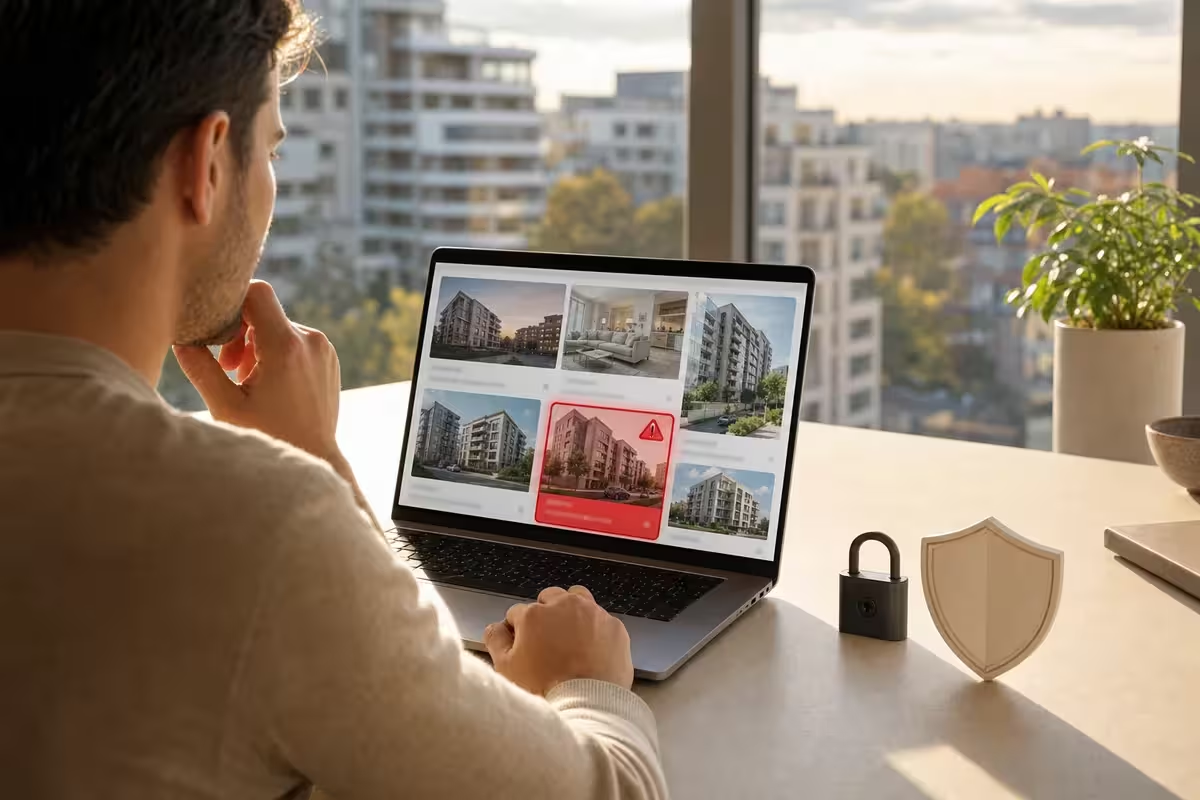
Scammers use similar techniques, whether they want to deceive tenants or buyers. Poliția Română describes in its materials on online fraud and phishing a clear pattern: alarming or overly advantageous messages, time pressure, promises of gain or a “unique offer”, combined with requests for advance payment or access to banking data.
On the listings market, including on large platforms, the press and operators have documented repeated cases of phishing, in which victims are lured by messages that direct them to fake pages, almost visually identical to the original ones. The goal is to obtain card data or access to online accounts.
Warning signs in a sale or rental listing:
- Price well below the market average for the area in question, without logical explanations.
- Overly “catalog-style” photos, clearly stock images, or those that appear to be taken from foreign websites; refusal to send additional personalised images.
- Very vague descriptions, with many grammatical errors, but insisting on “urgent”, “today only”, “unmissable price”.
- Request to continue the discussion exclusively on channels outside the platform, usually chat apps, where it is more difficult to report fraud.
- Request for an advance payment for “reservation” or “insurance”, before any viewing and without an official contract or receipt.
Many major listings platforms in Romania explicitly warn users to be careful about fake links for “paid items” or for delivery and payment services, as these links may be part of phishing campaigns. The common recommendation is not to follow links received in chat or via SMS, but to check the address directly in the browser and to use only the official flows displayed by the platform.
Safe payment: what you should never do and what alternatives you have
IGPR shows, in materials dedicated to online shopping, that one of the main mistakes made by victims is paying in advance, without real guarantees, either for products or for promised services. In the real estate area, the risk is even higher, because the amounts are considerable, and the consequences may mean losing a lifetime’s savings.
Basic principles for housing-related payments:
- Never pay rent or a purchase deposit based only on the listing and on phone or chat discussions.
- Do not send scans of your identity card or card details to “reserve” a home, regardless of who claims to be asking.
- Use transfers that can be proven (payment order, nominal bank transfer) and avoid services that are difficult to trace, especially to accounts abroad.
- Do not agree to pay into an account held in a name other than that of the person appearing on the documents or in the contract, without a clear legal explanation (for example, a developer or an agency that is registered and has been checked in advance).
When buying a home, the ANPC guide recommends that any preliminary agreement (bilateral promise of sale) be concluded in authentic form, before a notary, and registered in the land register. Thus, the deposit paid is based on a document with increased legal force, and the buyer’s rights are much better protected than by simple documents under private signature.
At the same time, ANCPI regulations provide for a special type of document, the land register excerpt for authentication, which is issued exclusively to the public notary before concluding a sale contract. This document confirms the current legal situation of the property, including any mortgages, prohibitions or disputes recorded in the land register.
Essential checks before sending money or signing the contract
Checking documents is the less spectacular part of a purchase or rental process, but it is the only one that truly protects you. ANPC and ANCPI indicate a series of steps that should become second nature for any consumer.
For purchases, the minimum verification steps include:
- Consulting a land register excerpt for information, obtained through the dedicated electronic platform or directly from the cadastral office, based on the cadastral number and land register number. The excerpt shows you who the owner is and what encumbrances the property has.
- Discussing with a public notary before paying a deposit or signing the preliminary agreement. The Ghidul cumpărătorului de locuințe, drawn up by ANPC together with notaries, highlights the notary’s role in checking the legal history of the property, the existence of disputes and the correct drafting of clauses.
- Checking that the developer or seller exists in the relevant public registers (trade register, local tax records) and requesting supporting documents, such as a tax attestation certificate or a confirmation from the owners’ association that expenses are paid up to date.
For rentals, although the financial stake is usually lower, the risk of fraud is high, especially in large cities and during busy periods (start of the academic year, tourist season). The basic safety rules are:
- Ask the owner for a document proving their right to dispose of the home (sale contract, recent land register excerpt).
- Request and sign a written rental contract, with full details of the parties and the property, even if the rent is paid in cash.
- Pay the deposit or guarantee only after viewing the home and signing the contract, and if the owner refuses a contract, reconsider the transaction.
In all cases, it is essential to keep all documents, receipts and relevant correspondence, so that you can later prove what was agreed and what payments were made.
Digital scams: phishing, impersonation of authorities and cloned websites
Modern real estate frauds often combine with digital attacks. Poliția Română and cyber security structures have reported, in recent years, phishing and impersonation campaigns targeting institutions, including Poliția Română and some authorities in the field of cyber security. Some websites display messages claiming that the user’s device has been blocked for accessing illegal material and demand rapid payment of a “fine”, under the threat of criminal proceedings.
These pages usually contain many spelling mistakes, confusing legal formulations and distorted names of institutions. Their purpose is to create panic and push the user to pay or provide sensitive data, such as card details or authentication codes.
To protect yourself:
- Do not access links received from strangers that promise “checking the property’s situation”, “fast payment of the deposit” or “online guarantees” for homes.
- Always check the website address in the browser bar and compare it with the official address of the institution or platform.
- Use additional security methods for online transactions, such as two-factor authentication systems and checking notifications from your bank.
- In case of any suspicion, contact the bank, notary or institution involved directly, using official contact details, not those in the message received.
If you have already been a victim of fraud or an attempt, save all digital evidence (emails, screenshots, messages, payment references) and contact the police and your bank urgently, to limit the damage and increase the chances of recovering the money.
Sources
Întrebări frecvente
Cum verific rapid dacă un anunț imobiliar este real?
Check whether the price is realistic for the area, ask for additional personalised images, refuse to pay in advance before viewing, and search online for the name of the owner or agency. Ideally, later confirm the legal status of the property through a land register excerpt and a discussion with a notary.
Este sigur să trimit avans pentru chirie înainte să văd locuința?
No. The deposit or guarantee should be paid only after viewing and signing a written contract. The owner’s refusal to sign a contract or to provide proof of ownership is a clear warning sign.
Cum mă protejez de linkuri și site-uri false legate de imobiliare?
Do not access links received from strangers or in suspicious messages, always check the website address in the browser, use only the official forms and flows of the platforms, and in case of any doubt contact directly the bank, notary or institution involved, using the contact details on their official websites.