

Why proof of accommodation is so important for foreign students
If you come to Romania as a student from a non-EU country, proof of accommodation is not just a bureaucratic formality. Without a clear document showing where you will live, your application for a long-stay study visa and later your application for a residence permit can be rejected or delayed.
The general legal framework is set by Government Emergency Ordinance no. 194/2002 on the regime of foreigners in Romania, which requires foreigners to present documents justifying the purpose and conditions of their stay on the territory of Romania, including accommodation conditions.
The Inspectoratul General pentru Imigrări (IGI) specifies in its guidelines for the long-stay study visa that, in addition to admission to studies, proof of financial means and a criminal record certificate, a document regarding accommodation conditions is also required, both for the visa and for the extension of the right of residence through the study residence permit.[1]
In practice, the study visa and residence permit file for foreign students is considered complete only if it includes a clear document indicating the accommodation address for the study period, issued by the university or derived from a legally registered lease agreement.
Which documents are accepted as proof of accommodation
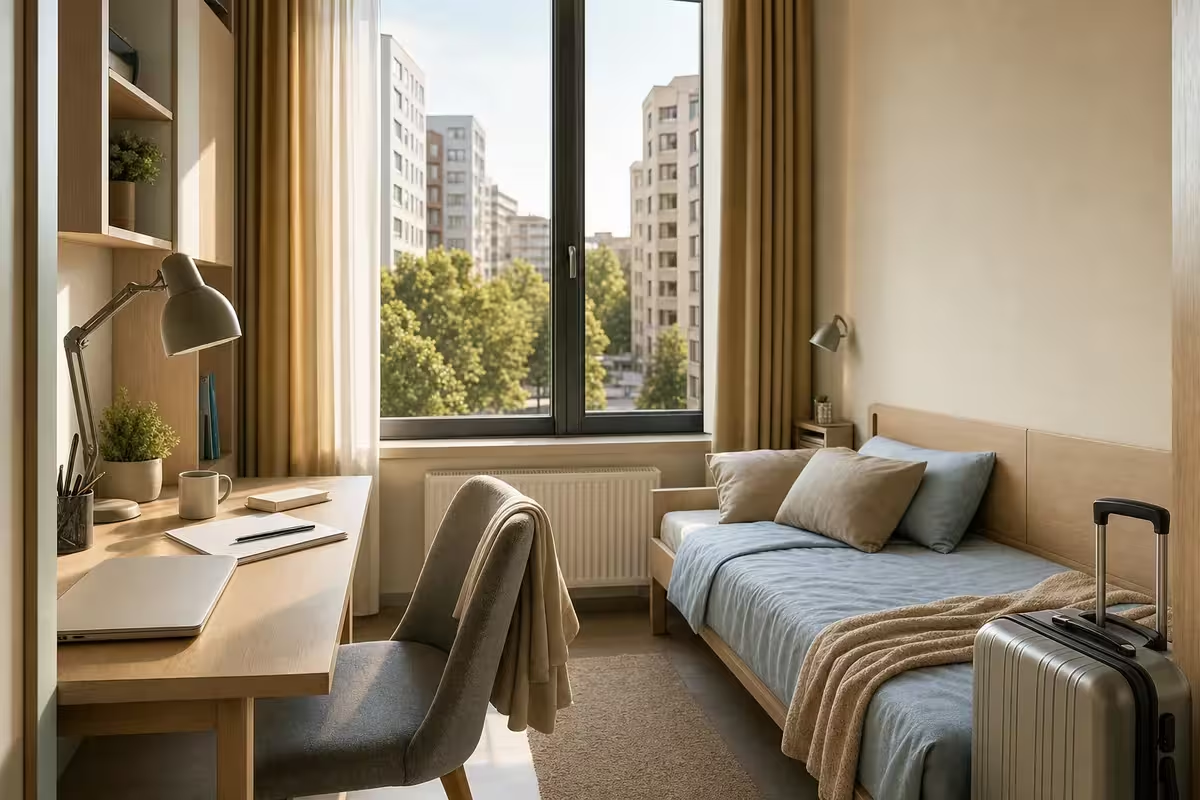
The exact list of documents may vary slightly depending on the embassy and the local IGI office, but generally the same types of documents are recognized at national level.
For foreign students, the most common forms of proof of accommodation are:
- Confirmation of accommodation in a student dormitory, issued by the university where you are admitted.
- Lease agreement for an apartment or a room, concluded with the owner and ideally registered with ANAF.
- Comodat contract or a hosting declaration from a person who accommodates you in their living space.
- Firm booking at a private dorm or hostel, where the embassy expressly accepts such proof for the first weeks of stay.
The official Euraxess România platform, which takes over the IGI requirements for the long-stay visa and residence permit, generally indicates the obligation to present documents attesting to the conditions of stay, including housing, at each extension of the right of residence.[2][3]
Romanian universities have started to structure these requirements in dedicated guides. For example, Universitatea Politehnica Timișoara explicitly explains that, after obtaining the letter of acceptance to studies, foreign candidates need proof of payment of the tuition fee and proof of accommodation when submitting the file for the Romanian visa.[4]
Accommodation in university dormitories: the confirmation letter
The simplest and safest option for proof of accommodation, especially for the first year of studies, is the university dormitory. The official Study in Romania website shows that most public universities provide dormitory places for international students, with monthly fees significantly lower than rent on the open market.[5]
The typical procedure is as follows:
- after admission, you contact the office for international students or the international relations department and request accommodation;
- the university usually confirms by e-mail the allocation of a place in the dormitory or the "right to request a place" upon arrival;
- you receive an official letter on the university letterhead, stating that you will have accommodation on campus for the duration of your studies or for the first semester / year;
- this letter is attached to the study visa file and later to the residence permit file, if IGI requests it.
Some universities, such as Universitatea „Alexandru Ioan Cuza” din Iași, directly link dormitory accommodation to the obligation to report to the Immigration Service to legalize your stay immediately after enrolment, precisely in order to link the accommodation address to the residence permit.[6]
The practical recommendation is to request the accommodation confirmation letter in good time and to make sure that it includes at least: your full name, the faculty / program, the accommodation period (for example, the 2026-2027 academic year) and the campus address.
Renting on the open market: contract, registration and comodat
Many foreign students prefer to rent, especially after the first year. In this case, proof of accommodation is based on the standard real estate documents.
In practice, for the IGI file, the following are mainly accepted:
- The lease agreement between the owner and the tenant, which states the full address, the rental period and the names of all persons living there.
- Proof of registration of the contract with ANAF or at least an associated fiscal document, confirming that the owner declares the rent.
- Comodat contract, when you do not pay rent but are hosted free of charge by a relative or acquaintance, accompanied by ownership documents or a land register excerpt for the property.
Experiences shared by students on forums and social networks confirm that, in the absence of a place in a dormitory, the fallback solution is often to ask the high school or university to help obtain an official form of accommodation, specifically to have a clear document recognized by IGI for visa and residence permit purposes.[7]
Even if not all embassies explicitly require the hotel or hostel booking to cover the entire visa period, for long-term study stays the authorities expect to see a coherent accommodation solution, preferably linked to the university or a stable lease agreement.
Timeline: when you need proof of accommodation
As a foreign student, in most situations you will have two key moments when you are asked for proof of accommodation:
- When applying for a long-stay study visa at the Romanian embassy or consulate. Euraxess România lists among the general documents for the long-stay visa those that justify the purpose and conditions of stay, including housing conditions.[2]
- When applying for or extending the residence permit at the local IGI office in the city where you study. The Euraxess guide for the residence permit emphasizes that the documents requested by IGI include, depending on the purpose, details regarding the place of stay in Romania.[3]
Universities are already instructing their international students to prepare these documents in advance. For example, Politehnica din Timișoara explicitly explains that proof of accommodation is required when submitting the visa application, together with proof of payment of the tuition fee.[4]
It is also important to respect the deadlines. The Study in Romania platform, in its guides on student life and dormitory accommodation, points out that universities set their own schedules for requesting dormitory accommodation and that places are limited.[8] If you delay, you risk losing your dormitory place and will have to find a rental, which complicates the visa and residence permit file.
Practical recommendations for a file without surprises
To avoid delays or refusals, it is worth treating proof of accommodation as seriously as the letter of acceptance to studies.
- Request the dormitory accommodation letter immediately after you receive acceptance to studies; do not wait until just before the visa file submission deadline.
- If you choose to rent on the open market, insist that the owner signs a written contract and ideally registers it with ANAF. This will greatly facilitate your relationship with IGI.
- Keep printed and scanned copies of all accommodation documents, with translations into English or Romanian where necessary.
- Double-check the address in all documents lease agreement, letter from the university, IGI forms. Any discrepancy may lead to additional requests.
- Before going to IGI, consult the updated guides on the official websites (IGI, Euraxess, Study in Romania) and, if possible, request written confirmation from your university’s international students office regarding which documents are accepted in that county.
Even if the general rules are set at national level through Government Emergency Ordinance no. 194/2002, the way the file is checked in practice may vary slightly from one local IGI office to another, which is why good communication with the university and, if necessary, with the Romanian embassy in your country is essential.
Sources
- Inspectoratul General pentru Imigrări – Cum pot să obțin o viză de lungă ședere pentru studii?
- Euraxess România – Viza de lungă ședere
- Euraxess România – Permisul de ședere
- Universitatea Politehnica Timișoara – Cazare studenți din țări terțe și dovada de cazare pentru viză
- Study in Romania – Tuition fees & living costs (secțiunea despre cazare)
- Study in Romania – Cămine studențești și condiții de cazare
- Universitatea „Alexandru Ioan Cuza” din Iași – Cazare studenți și proceduri legate de ședere
- OUG nr. 194/2002 privind regimul străinilor în România
- Discuție practică despre viză, permis de ședere și dovada de cazare pentru elevi și studenți în România
Întrebări frecvente
Ce pot folosi ca dovadă de cazare pentru viza de studii în România?
Authorities mainly accept: confirmation of accommodation in a dormitory issued by the university, lease agreement (ideally registered with ANAF), comodat contract or, in certain cases, a firm booking at a private dorm or hostel, if the embassy explicitly mentions it in the list of accepted documents.
Este obligatoriu să am contractul de închiriere înregistrat la ANAF pentru permisul de ședere?
The law does not explicitly require you to present proof of registration with ANAF, but in practice many local IGI offices request or prefer it in order to verify the housing situation. This is why it is recommended to choose an owner willing to correctly sign and declare the contract.
Pot obține viza de studii doar cu o rezervare la hotel sau hostel?
For short stays, some embassies accept proof of accommodation through a hotel booking. For a long-stay visa for study purposes, however, the authorities expect a stable accommodation solution, such as a university dormitory or a lease agreement. The safest option is to have an accommodation letter from the university or a longer-term lease.