

New or old apartment: what price differences look like in the major cities
The choice between a new and an old apartment has long ceased to be a purely emotional decision. In the context of rising prices and intense discussions about seismic risk and energy efficiency, carefully comparing costs and risks has become mandatory for any buyer or investor.
Recent data shows that the price differences between new and old are not always in favor of new homes. In București, an information bulletin of the Senatul României, based on the Indicele Imobiliare.ro, shows that in January 2024 the average asking price for new apartments was 1,705 euro/sq m usable, while old apartments had an average price of 1,732 euro/sq m, slightly higher.
In Cluj-Napoca, the same document shows a reverse situation, but with small differences: in January 2024 new apartments had an average price of 2,596 euro/sq m, and old ones 2,560 euro/sq m. In practice, in large cities the price gap between new and old segments has narrowed, and the decision can no longer be made solely on the basis of the listed price.
An Imobiliare.ro report for Q1 2024 shows, at national level, an average price of 2,631 euro/sq m in Cluj-Napoca for apartments (new and old), with an increase of over 14% in two years, which confirms the general upward pressure on housing prices, regardless of age.
In București, old apartments ended up in January 2024 being on average slightly more expensive than new ones, a sign that location and infrastructure can weigh more than the year of construction.
VAT and the real acquisition cost: when the advantage is for new and when for old
The VAT regime directly influences the final cost of a new apartment. According to the Ministerul Finanțelor and ANAF, as of 1 January 2024 the reduced VAT rate for the delivery of homes as part of social policy was increased from 5% to 9%, for homes up to 600,000 lei (without VAT) and a maximum of 120 sq m usable.
In practice, for a new apartment with a price of 600,000 lei without VAT, the buyer previously paid 630,000 lei with 5% VAT, while in 2024 they pay 654,000 lei with 9% VAT. The difference of 24,000 lei is relevant for the budget and can tip the balance towards an old apartment in the same area, where VAT is no longer applied on resale between individuals, the cost being influenced mainly by the market price, notary fees, and any mortgage loan.
In the segment above the threshold (or when the conditions for reduced VAT are not met), new apartments are sold with the standard 19% VAT, which further increases the total cost relative to the list price.
On the other hand, old apartments often have negotiable prices and are not subject to VAT rules for the delivery of new homes. However, the VAT difference must be weighed together with the renovation cost and long-term risks, not in isolation.
Renovation and energy efficiency: between hidden costs and lower bills
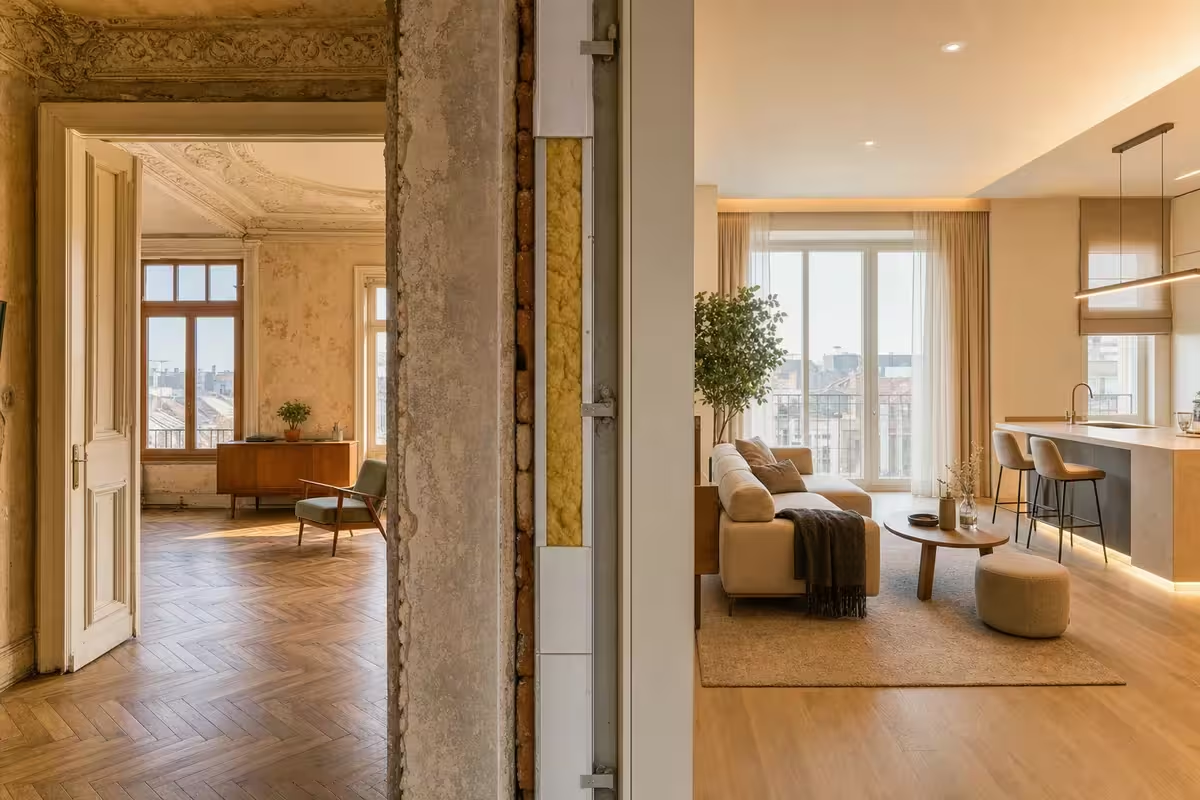
If a new apartment seems more expensive at the time of purchase, many of the future costs are “hidden” in the initial price: new installations, thermal insulation in line with current standards, modern individual or central heating systems, high-performance joinery. In contrast, for an old apartment, especially one built before 1990, the buyer must realistically budget for renovation and energy rehabilitation costs.
Current regulations on the energy performance of buildings, detailed in national legislation and in regulations on nearly zero-energy buildings (nZEB), require very high energy performance for new buildings and a share of at least 30% energy from renewable sources starting from 2021. In practice, this means better insulated walls, efficient joinery, and technical solutions that significantly reduce energy consumption for heating and cooling.
For an old apartment, even if the building has undergone thermal refurbishment, its energy efficiency may still be lower than that of a new nZEB project, and the difference shows up in the monthly bills. In the long term, savings on utilities can offset part of the higher price paid for a new apartment, especially in cities where winters are long and the cost of gas or electricity remains high.
- New apartment: higher initial cost, but lower energy consumption, new installations, better thermal comfort.
- Old, non-refurbished apartment: potentially lower purchase price, but requires investments in windows, installations, insulation, which can quickly reach several hundred euro/sq m.
- Old, refurbished apartment: attractive compromise in terms of price, but energy performance depends heavily on the quality of the works and the age of the refurbishment.
Seismic risk and the cost of peace of mind: what real differences exist between new and old buildings
In Romania, seismic risk can no longer be ignored in the purchase decision, especially in cities such as București. The Administrația Municipală pentru Consolidarea Clădirilor cu Risc Seismic and the Primăria Municipiului București provide lists and maps of buildings that have undergone technical assessments and have been assigned to risk classes RS I–RS IV and urgency categories, information that must be checked before purchase.
A recent technical guide shows that in București there are almost 2,800 assessed buildings, of which over 400 are in seismic risk class I and almost 500 in class II. These are the most problematic in terms of earthquake safety and financing, with many banks refusing mortgage loans for buildings in RS I or RS II.
New buildings are designed according to current seismic design codes, updated after the 1977 earthquake, which theoretically gives them a better level of safety. However, construction quality can vary, and the lack of a technical assessment does not automatically mean that an old building is safe. Many buildings constructed before 1977 have not yet been assessed, and the cost of a technical assessment for a building can reach tens of thousands of lei, an amount that must be borne by the owners’ association.
In addition, some optional home insurance policies explicitly exclude coverage for earthquake damage for buildings in seismic risk classes I, II, or III or in urgency categories U1–U3, which further increases the financial risk for a buyer entering a vulnerable building.
In cities outside areas with high seismic hazard, the impact on price may be smaller, but for București, a careful analysis of seismic risk often makes the difference between a “cheap deal” and a major investment mistake.
Maintenance, total cost of ownership, and resale value
The total cost of an apartment is not limited to the transaction price. Maintenance fees, costs of repairs to common areas, insurance, and, ultimately, resale value matter at least as much, especially for investors.
In old buildings, major repairs to common installations, elevators, or roofs can mean substantial contributions per apartment, especially where the repair fund is insufficient. In new buildings, maintenance costs may initially be lower, but there may be higher common expenses in complexes with extensive facilities (underground parking, security, large common areas).
Resale value is influenced by a combination of factors: location, access to public transport, construction quality, energy efficiency, and seismic risk. Data aggregated by portals such as Imobiliare.ro, reflected also in market reports and institutional bulletins, shows that in large cities well-located and energy-efficient apartments retain their value better, whether they are in new or old buildings.
For investors, rental yield must be assessed relative to the total acquisition cost (including VAT and commissions), renovation costs, and the outlook for value growth or stagnation over time. In some central or semi-central neighborhoods, a well-renovated old apartment can offer a better net yield than a new apartment on the outskirts, even if the price per square meter is similar.
Conclusion: how to correctly choose between a new and an old apartment
There is no universally valid answer to the question “new or old apartment”. The right decision is the one based on figures and on risk analysis for your specific case.
- Compare the total price: sale price, VAT (for new), notary fees, commissions.
- Realistically estimate the renovation cost for an old property and check the technical documentation for a new one.
- Check energy efficiency and the performance certificate, not just facade insulation.
- Analyze seismic risk using official lists and maps and the policies of the bank and insurer.
- Think in terms of total cost of ownership over 10–20 years, not just price per sq m.
In markets such as București and Cluj-Napoca, where average price differences between new and old are relatively small, criteria such as earthquake safety, energy efficiency, and neighborhood quality can weigh more than the year of construction itself.
Sources
- Senatul României – Buletin informativ 1–15 februarie 2024, date Indicele Imobiliare.ro despre prețurile apartamentelor noi și vechi în București și Cluj-Napoca
- Imobiliare.ro – Raport piața rezidențială T1 2024, evoluția prețurilor în marile orașe
- ANAF – Clarificări privind cota redusă de TVA de 9% pentru livrarea de locuințe începând cu 1.01.2024
- Legislație Just.ro – Reglementări privind clădirile nZEB și performanța energetică a clădirilor în România
- Administrația Municipală pentru Consolidarea Clădirilor cu Risc Seismic – informații și liste imobile expertizate în București
- Verificatori.ro – informații privind expertiza tehnică și situația clădirilor cu risc seismic
Întrebări frecvente
Is a new apartment always safer than an old one?
Not necessarily. New apartments are designed according to stricter seismic standards and, in principle, have better energy performance. However, construction quality varies, and some old buildings, well designed and possibly consolidated, can be safer than new constructions built with a focus only on price. Check the technical documentation, the building’s history, and consult a structural engineer if you have doubts.
How does VAT influence the choice between a new and an old apartment?
For new homes up to 600,000 lei and 120 sq m usable, a reduced VAT rate of 9% applies starting from 2024. Above this threshold or in other conditions, the standard VAT of 19% applies. For old apartments, transactions between individuals do not include VAT, but you must factor in renovation costs and any seismic or energy risks.
What should I check before buying an old apartment in București?
First, check whether the building appears on the official list of buildings with seismic risk or on dedicated maps. Analyze the year of construction, whether it has undergone thermal refurbishment, and whether there is a recent technical assessment. Discuss with the bank and an insurance broker to see how the building’s risk is perceived and what limitations exist for financing and insurance. Additionally, budget realistically for renovation costs and potential repairs to common areas.