

Why buying from a developer in 2026 is different
The new apartment market remains extremely active in the major cities, but the legal framework and commercial practices have been refined in recent years. In 2026, buyers have more official tools to verify a real estate project, but also more contractual pitfalls, from large down payments to unrealistic completion deadlines.
Authorities such as ANPC and ANCPI have published updated guides and regulations that explain the correct steps of a transaction, from checking the legal situation in the land register to the final registration of the apartment. These resources, combined with attention to the content of the preliminary contract and to the conditions of acceptance and connection to utilities, make the difference between a safe and a risky purchase.
Before signing any document and paying a significant down payment, request an updated land register excerpt and a copy of the building permit, then carefully review the preliminary contract together with a notary or lawyer.
Checking the developer: building permit and land register
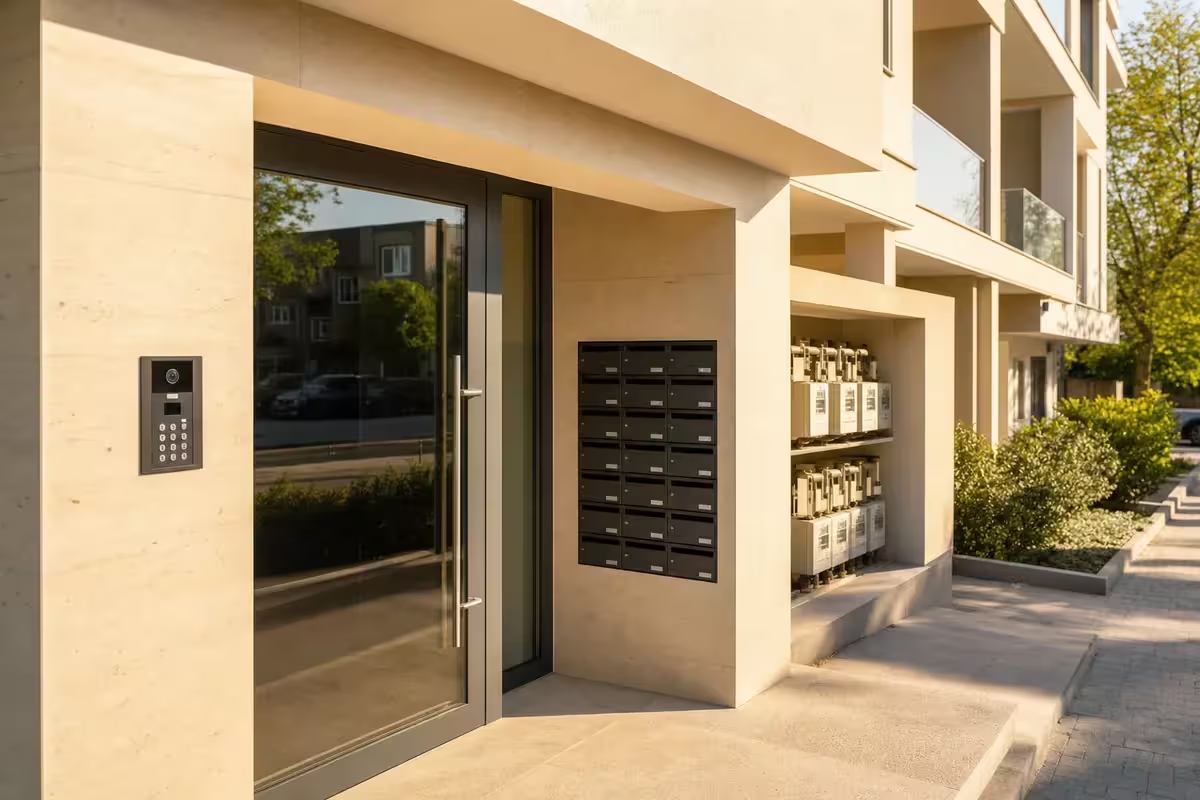
The first step is to verify the project itself, not just the apartment. The developer must hold a valid building permit issued for the building you are buying in, and the construction must be carried out within the limits and conditions of that permit. The absence of the permit or major deviations from it can lead to the impossibility of acceptance and registration or to additional costs for legalisation.
Equally important is the legal situation in the land register. ANCPI makes available to the public the land register excerpt for information, an official document that shows the owner of the land and the building, the surface area, the usage categories and any encumbrances or restrictions, such as mortgages or ongoing disputes.[1] The excerpt can be obtained online or from the land register office within 1–2 working days, according to the service times published by the ANCPI territorial offices.[2][3]
In practice, you must verify at least:
- whether the developer is the owner of the land or has a real right allowing it to build and sell;
- whether there are mortgages or other encumbrances on the land or building (for example, large bank loans in favour of the project’s financier);
- whether the destination of the property is “residential” and whether the surface area and description match the documentation presented;
- whether the property or future goods (the apartments) are already provisionally registered in the land register, in accordance with the pre-apartmenting rules;
Recent buyer guides stress that analysing the land register excerpt and verifying the owner are essential steps that must be carried out before signing any preliminary contract or paying a down payment.[4][5]
The preliminary contract and the down payment: how to protect your money
The preliminary contract (bilateral promise of sale and purchase) is the document that fixes the price, the payment schedule and the conditions under which the final contract will be signed with the notary. Developers frequently request significant down payments at this stage, usually between 10 and 25 percent of the price, a proportion also confirmed by market practice in large new housing projects.[6]
In the “Homebuyer’s Guide” published in 2026, ANPC strongly recommends that the down payment be correlated with the degree of completion of the construction and with the guarantees offered to the buyer.[4] Before paying significant amounts, the following must be clarified in writing:
- the conditions under which you can recover your down payment if the developer does not meet the completion deadline or does not obtain acceptance and registration;
- what happens if the bank does not approve the loan; for the buyer, the reasonable solution is to insert a suspensive clause related to obtaining financing;
- penalties for delays, both for the developer and for the buyer;
- how the price will be updated, if applicable (indexation, VAT changes etc.).
Market practice guides recommend that the preliminary contract be executed in authentic form before a notary, not just under private signature, to allow the registration in the land register of a receivable right or a promise of sale, which gives the buyer an additional level of legal protection.[6]
Registration and the final deed: from future good to apartment “in the land register”
In new projects, the buyer often contracts a “future good”. The cadastral legislation and the ANCPI regulations updated in 2023 and 2026 provide clear procedures for the provisional registration of these goods in the land register, through pre-apartmenting and then through registration after completion of the construction.[7][8] Without these stages, the sale and purchase contract in authentic form cannot be concluded and the mortgage required for a mortgage loan cannot be created.
After acceptance of the works and preparation of the cadastral documentation, the notary submits to the cadastre office the application for registration of the apartment and of your ownership right. According to information published by ANCPI and specialised portals, the registration fee for individuals is generally 0.15% of the value in the deed, while for legal entities it reaches 0.50%.[1][9]
The standard time for registration is usually a few working days, and the land register excerpt for information, which certifies your status as owner, can be obtained online in 1–2 working days, depending on the office.[2][3] Only after the right is registered can you consider the transaction legally completed and can you use the dwelling as collateral for future loans or sell it without risks.
Acceptance, utilities and what “deliverable apartment” means
Another sensitive point in transactions with developers is the difference between a block that is “almost ready” and one that has been accepted, is connected to utilities and has deliverable apartments. Construction legislation, updated through technical and acceptance regulations, provides that a building can be used only after acceptance upon completion of the works and obtaining the necessary approvals for putting the installations into operation.[7]
For the buyer, a few checks are essential before signing the final contract:
- the existence of the acceptance report upon completion of the works, signed by the acceptance commission and the developer;
- definitive connection to utility networks: electricity, gas, water, sewage, internet, not just temporary solutions;
- the possibility of concluding individual utility supply contracts in the owner’s name;
- the compliance of the apartment with the layout and finishes in the preliminary contract (usable areas, partitioning, fittings);
- delivery of the handover report and of the building manual, where the developer makes it available.
ANPC warns in its guide that handing over a dwelling in the absence of these elements can create major difficulties for the buyer, from the impossibility of actually moving in to additional costs for later connections.[4]
Safety checklist for buying a new apartment
To summarise, safely buying an apartment from a developer in 2026 means treating the transaction as a multi-stage project, not as a simple signing of documents. Before you decide:
- check the building permit, urban planning certificate and the developer’s track record;
- request an up-to-date land register excerpt for information, both for the land and for any future goods;
- read the preliminary contract carefully, negotiate the clauses on the down payment, deadlines and penalties and, ideally, consult a notary or lawyer;
- make sure that the pre-apartmenting and registration procedure is underway and that the developer can deliver an apartment with its own land register entry;
- do not sign the final contract until the block has been accepted and connected to utilities and the apartment matches what you contracted.
In the context of high prices and selectively stricter lending, each point on this checklist can mean tens of thousands of euros protected or, conversely, exposed to risk. Use official resources, ask questions and do not rush to sign.
Sources
- ANCPI – Întrebări frecvente și Ghidul cetățeanului (cadastru și carte funciară)
- OCPI Constanța – Termene servicii (extras de carte funciară și intabulare)
- ANCPI Online – Cum se face intabularea unui apartament nou în România
- AGERPRES – ANPC a publicat un ghid pentru cumpărătorii de locuințe (2026)
- Onyx Residence – Ghid de cumpărare apartament nou, pași practici (actualizat 2026)
- Extrasul.ro – Ce să verifici în cartea funciară înainte să cumperi
Întrebări frecvente
What should I check in the land register before buying a new apartment?
Check the owner of the land and the building, the existence of mortgages or other encumbrances, the designation of the property as a dwelling, the surface area and description of the apartment, as well as any provisional entries for future goods. All these appear in the land register excerpt for information issued by ANCPI.
What down payment is reasonable to pay for an apartment from a developer?
In practice, developers frequently request between 10% and 25% down payment relative to the apartment price. What matters is not just the percentage, but also the protection offered by the preliminary contract: the conditions for refunding the money, penalties for delays and the correlation of the down payment with the stage of construction.
Can I sign the final contract if the block has no acceptance and no definitive utilities?
It is very risky. Without acceptance upon completion of the works and definitive connection to utilities, there is a risk that you will not be able to actually live in the apartment or that you will face high completion costs. The recommendation is to condition signing the final contract and full payment on the existence of acceptance, connection to utilities and registration documentation.