

Context: why it is important to rent in an informed way
The rental market has become increasingly competitive in large cities, and rushed decisions can mean high long-term costs. A Storia report published in 2024 shows that rental prices have increased by approximately 15% compared to the previous year, against the background of high demand in university centers and in București.[1] In this context, knowing exactly what you have to do, step by step, from choosing the home to registering the contract with ANAF, is no longer a luxury, but a necessity.
In the lines below you will find a practical guide, focused on concrete steps, so that you can avoid unpleasant surprises and have a fair contract for both you and the owner.
Starting 1 January 2023, individual owners are legally obliged to register the rental contract with ANAF within a maximum of 30 days from signing.[2]
Step 1: define your budget and real needs
Before looking for listings, clarify three things: the maximum monthly budget, the area and the type of home. The Storia report for 2024 shows that two-room apartments are the most sought after on the rental market, preferred for their good cost-to-comfort ratio.[1] This also means that they are rented quickly, so it is important to know what you want before calling owners or agencies.
Ask yourself:
- How much can you afford to pay monthly, including service charges and utilities?
- Do you need parking, quick access to the metro or to the university?
- Are you more interested in peace and quiet or proximity to the center and office areas?
Set a price range and make a short list of neighborhoods. Then compare the offers on the main real estate portals and in agency listings, so that you have a realistic picture of prices and do not waste time with offers that are unsustainable for you.
Step 2: what to check at the viewing, beyond the “first impression”
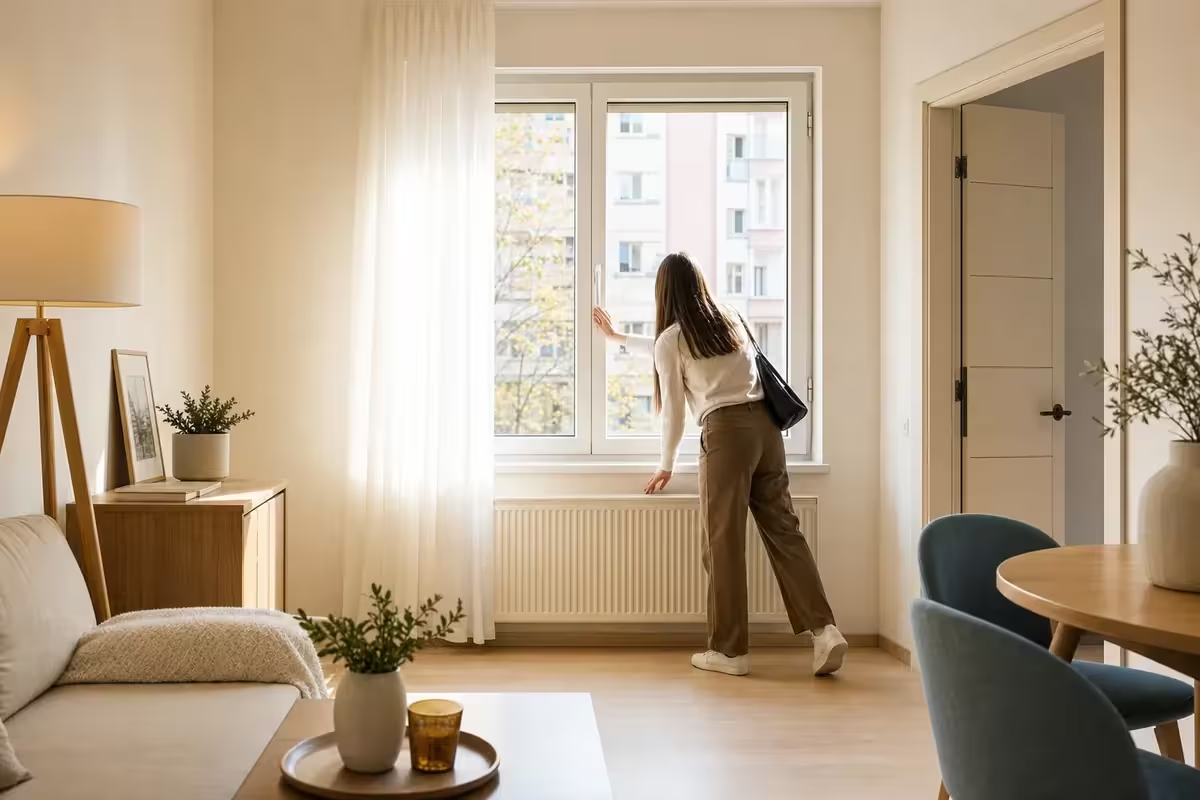
The viewing is the moment when you can discover hidden problems before committing contractually. Do not limit yourself to the general appearance. Go prepared with a checklist and write down your observations, especially if you see several apartments on the same day.
Essential checks on site:
- Installations and consumption: check the taps, water pressure, how the home is heated (own boiler, city district heating), the type of meters and their location.
- Condition of windows and insulation: old joinery or windows that do not close properly can mean high heating costs.
- Noise and neighborhood: listen to the noise from the street, from the stairwell, from neighbors. Ideally, schedule a viewing in the evening as well.
- Furniture and appliances: check that they work, ask the owner to include in the contract the exact list of items and their condition.
- Service charge costs: ask specifically how much the service charges were in the winter and summer months, as well as the average utility bills over the past year.
Do not hesitate to take photos with the owner’s consent, so that you can compare later and have evidence in case discussions arise about the condition of items when you move out.
Step 3: documents you must ask for before signing
Before you get to the contract, ask for a few basic documents. These give you the assurance that the person you are speaking to is actually the owner or has the right to dispose of the property and that you are not entering a legally uncertain situation.
- Title deed (sale-purchase contract, certificate of inheritance, handover report from the developer, etc.). Ask to see the original or a certified copy.
- Land register extract for information purposes, issued recently. It can be obtained online from the integrated cadastre and land register system managed by ANCPI, via ePayment, in a few minutes.[3] Here you can see whether there are mortgages, encumbrances or disputes that could affect you.
- The owner’s identity document and, where applicable, the notarized power of attorney of a person signing on their behalf.
- Certificate from the homeowners’ association showing whether there are significant arrears in service charges, especially for common utilities.
If you rent through an agency, check what commission you pay, to whom, and under what conditions any advance payment is refunded if the transaction does not go through.
Step 4: how to sign the rental contract correctly
The Housing Law no. 114/1996 provides that the renting of homes must be done through a written contract, in which the main rights and obligations of the parties are expressly mentioned.[4] Even if, in theory, some verbal agreements would be civilly valid, in practice you are left without real legal protection in the event of a dispute.
In a well-drafted rental contract you should find at least:
- Exact identification of the parties (including personal numerical code/ID series, home address).
- Full description of the property and the annexes used (storage room, parking space, yard).
- Duration of the contract, conditions for extension and early termination.
- Amount of rent, the currency in which it is paid, due date, method of adjustment (for example, according to inflation or through annual renegotiation).
- Amount of the guarantee (security deposit), conditions and deadline for refund.
- Annexed list of furniture, appliances and their condition, possibly with photos attached.
- Clear allocation of costs: who pays service charges, routine repairs, local taxes.
It is recommended that each page be signed by both parties and that each keeps an original copy. If there are unclear clauses, ask for explanations or consult a lawyer or legal adviser, especially for long-term contracts.
Step 5: registering the contract with ANAF and long-term security
An essential aspect, often omitted, is registering the contract with ANAF. According to the Fiscal Code, updated by Government Ordinance no. 16/2022 and the subsequent procedures approved by ANAF, individual owners who obtain income from letting the use of goods are obliged to register the rental contract within a maximum of 30 days from signing.[5] The procedure is carried out by submitting form C168, including online, through ANAF’s Spațiul Privat Virtual.[6]
What you gain as a tenant if you insist that the owner fulfils this obligation:
- You have clear proof of the rental relationship before public institutions, banks or employers, if you need to prove your residence.
- There is fiscal traceability, which discourages abuses related to arbitrary rent increases or improvised evictions.
- In case of a dispute, the registered contract has stronger and clearer evidentiary value.
As a good practice, ask the owner for a copy of the proof of registration or of the confirmation from Spațiul Privat Virtual after submitting the form. This way you know that everything has been done according to the law and that the owner–tenant relationship starts on a proper footing.
Conclusion: quick checklist before you become a tenant
In a market where rents have increased significantly in recent years and demand remains high in major urban centers, renting “at random” is a risk you can no longer afford. By going through the above steps, you turn the search process into a calculated decision, not a gamble.
- Set your budget and target neighborhoods, taking into account total monthly costs.
- Check the home carefully during the viewing, not just the aesthetics, but also the installations and neighborhood.
- Ask for the owner’s documents and, ideally, a recent land register extract.
- Make sure you have a written, clear contract, with all the important clauses and the inventory list.
- Encourage and check the registration of the contract with ANAF within the legal deadline.
With a minimum of attention and documentation, renting becomes a manageable process that protects your interests and gives you the stability you need at home.
Sources
- Agerpres / Storia: Piața chiriilor în 2024, evoluții și tipuri de locuințe căutate
- ANCPI: Servicii online pentru extras de carte funciară și ePayment
- Fiscalitatea.ro: Obligația înregistrării contractelor de închiriere la ANAF după 1 ianuarie 2023
- ContractInchiriere.ro: Ghid practic 2026 pentru înregistrarea contractului la ANAF, formularul C168
- LawPedia: Contract de închiriere locuință, drepturi și obligații conform Codului civil și Legii locuinței
Întrebări frecvente
Is it mandatory to have a written rental contract?
Yes. For homes, the Housing Law and legal practice require the written form of the contract, so that rights and obligations are clearly established and easy to prove.
Within what period must the rental contract be registered with ANAF?
The individual owner is obliged to register the contract with ANAF within a maximum of 30 days from signing, according to the Fiscal Code updated after 1 January 2023.
What level of deposit is reasonable to pay when renting?
In practice, the usual level is 1, at most 2 months’ rent as a security deposit, but the exact amount is negotiated and must be clearly included in the contract, including the refund conditions.