

Why checking the documents before buying a home is essential
In a volatile real estate market, where the number of transactions and mortgage loans is closely monitored by BNR, attention to legal details becomes a form of financial protection. The BNR financial stability report for 2024 shows that households’ exposure to mortgage loans is one of the main vulnerabilities, which means that a wrong purchase can have long-term effects on the family budget.
In this context, a home's documents are not a formality left to the notary, but a chapter that every buyer must understand. Checking the land register, encumbrances, building permits and tax documentation can save you years of litigation and additional costs.
The first mandatory filter before paying any deposit is a recent land register excerpt, issued by ANCPI, which shows who owns the property and what encumbrances affect it.
The land register: the document that tells you who is selling and what you are actually buying
The land register is the public record that describes the legal status of the property: who owns it, what surface area it has, how it is identified in the cadastre and what encumbrances are registered on it. The land register excerpt is the official document issued by ANCPI based on these records.
According to guidelines and specialist platforms that work with ANCPI, the land register excerpt contains essential information: identification data (cadastral number, address, surface area, land use category), the owners and the deeds under which ownership was acquired, as well as active encumbrances mortgages, prohibitions on disposal, easements or ongoing litigation. These elements are structured in three parts, the third part being dedicated to the encumbrances of the property.
The excerpt can be obtained directly from the ANCPI system, including online, through the ePay.ancpi.ro platform, where a land register excerpt for information purposes is available, with a fee set by order of the ANCPI director general. The document is issued electronically and bears the institution’s digital signature, which allows the authenticity to be checked via the barcode on the first page.
- Make sure that the address and cadastral number correspond exactly to the property you visited.
- Check whether the seller in the preliminary sale agreement is the same as the owner registered in the land register.
- Review the third part of the excerpt, where mortgages, prohibitions on disposal, attachments and litigation are listed.
- Do not rely on old copies; always request a recent excerpt issued for information purposes.
What encumbrances in the land register mean and how they can block you
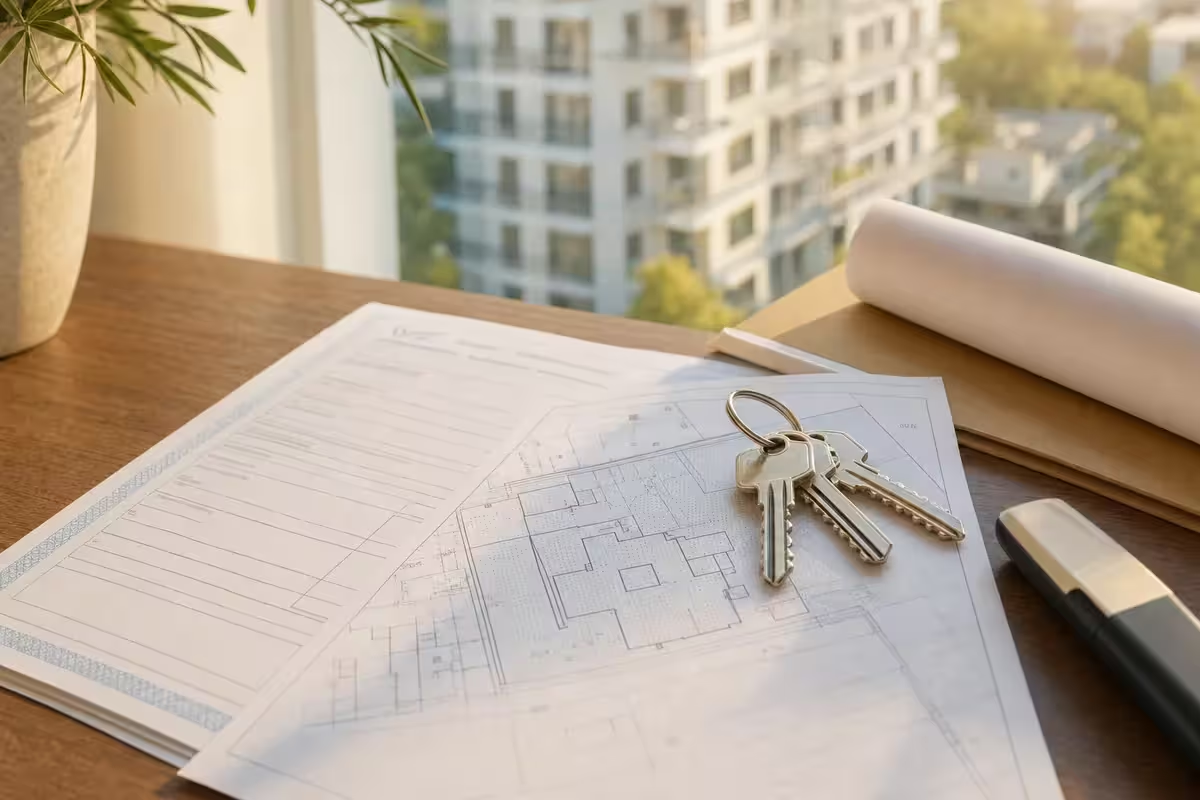
The encumbrances registered in the land register represent any right or limitation that affects the use or disposal of the property. Real estate advisory and land register excerpt platforms frequently explain that the most common encumbrances are mortgages, prohibitions on disposal and attachments, but there may also be easements or ongoing litigation.
The mortgage is usually constituted in favour of a bank, for the loan through which the current owner purchased the home. The presence of a mortgage does not automatically mean that you cannot buy, but it does mean that the transaction must be structured so that the mortgage is repaid and deleted from the land register at the same time as the sale, usually from the price paid by the new buyer or from a new loan.
The prohibition on disposal blocks the sale until it is removed. It may be established in favour of the bank, the state or another person. An attachment imposed by an authority or a court also blocks disposal for the duration of a case. These encumbrances are detailed in the land register excerpt and must be analysed together with the notary or a lawyer.
ANCPI also provides for the possibility of issuing an encumbrance certificate, a separate document confirming whether or not a property is subject to encumbrances based on the data in the land register, at a fee set by Order no. 16 of 2019. This certificate can be useful when you want additional confirmation of the status of the property based on the full address.
- Avoid signing any preliminary contract without clarifying how existing mortgages will be repaid.
- Check whether there are prohibitions on disposal or attachments and ask the notary to explain their effects.
- Write down the registration numbers of the entries under which the encumbrances were registered, so that you can discuss them with a specialist.
Permits, technical documentation and the notary’s role in checking the documents
The land register does not say everything about a property, especially in the case of buildings. For apartments in new blocks or for individual houses, checking the building permit, the completion acceptance report and the registration of the building in the land register is essential.
The home buyers’ guide, drawn up in 2026 with the support of public notaries and consumer protection authorities, emphasises that the notary is obliged to check the seller’s ownership documents, the legal history of the property, the existence of encumbrances, prohibitions on disposal and litigation, as well as the relevant public registers. The notary also checks the existence of administrative acts and prior approvals, such as the tax clearance certificate, the certificate from the owners’ association, the energy performance certificate and other documents required by law.
Even though the notary has this legal role, not all technical or urban planning issues can be identified solely at the office. Therefore, for new buildings it is also recommended to check the urban planning documentation urban planning certificate, building permit, any subsequent changes, as well as to have a discussion with a technical specialist in more complex cases.
- Ask the seller for the building permit and completion acceptance report for new houses.
- Request the energy performance certificate before signing the contract.
- Check with the town hall whether there are any disputes or administrative procedures concerning the property or the area.
Practical checklist: what a serious minimum check looks like
Beyond legal concepts, the buyer needs a clear list of steps. The practice of notaries and the recommendations of lawyers in real estate due diligence outline a minimum but robust verification scheme before you commit to a transaction.
- Ownership documents: the previous sale and purchase contract, deed of gift, certificate of inheritance, court judgment or ownership title, depending on the situation.
- Land register excerpt for information purposes: recently issued by ANCPI, through OCPI or via the ePay portal, confirming the owner, surface area and encumbrances.
- Checking encumbrances: mortgages, prohibitions, attachments, easements or litigation registered in the third part of the land register, possibly also an encumbrance certificate.
- Technical and urban planning documentation: building permit, completion acceptance report, cadastral plans, certificates and approvals from the town hall where applicable.
- Tax and utilities documents: tax clearance certificate from the town hall, certificate from the owners’ association regarding up-to-date payment of maintenance charges, status of utility contracts.
- Specialist advice: a prior discussion with the notary you choose, not just the one proposed by the seller, and, if necessary, with a lawyer or a technical expert.
Before paying a deposit or signing a preliminary contract, make sure that you have gone through all these steps and that you have clarified with the notary all doubtful elements in the land register or in the technical documentation.
Întrebări frecvente
Ce este extrasul de carte funciară și de ce este important?
The land register excerpt is the official document issued by ANCPI which shows the current legal status of a property owners, surface area, cadastral identification and all registered encumbrances. It is the first document you must check before paying any deposit for a home.
Cât de recent trebuie să fie extrasul de carte funciară?
For a sale and purchase transaction, it is recommended to use an excerpt issued as close as possible to the signing date, usually no more than a few days old. This way you make sure that no new encumbrances have appeared between the viewing and the transaction.
Mai trebuie să verific eu actele dacă oricum se ocupă notarul?
Yes, it is prudent to understand the basic documents before you get to the notary. The notary has the legal obligation to check the legal status of the property and to consult the public registers, but you are the one who assumes the loan and the financial risk. A prior discussion with the notary and basic research on the land register excerpt give you time to identify and clarify any issues before signing the contract.
Cum procedez dacă imobilul are ipotecă înscrisă în cartea funciară?
The presence of a mortgage does not automatically block the transaction, but it means that the sale must be organised so that the mortgage is repaid and deleted at the time of signing. Usually, this is done by paying the bank directly from the sale price or from a new mortgage loan. The specific arrangement is agreed together with the bank, the notary and the seller, and the clauses regarding repayment of the mortgage must be clearly provided in the contract.
Ce alte documente, în afară de cartea funciară, ar trebui să verific pentru o casă nouă?
For a new house you need to see the building permit, the completion acceptance report, the cadastral documentation and, ideally, the urban planning certificate and any related approvals. You should also request the energy certificate, the tax clearance certificate from the town hall and, where applicable, the certificate from the owners’ association or from the developer regarding common charges.