

Coliving & flatmates: why it has become a budget dilemma
In major university cities and economic centers, the decision where you live is no longer just a matter of comfort, but one of financial strategy. Student dorms, classic rent in an apartment and living with flatmates all have clear advantages and disadvantages, especially in a market where rents have risen significantly in recent years.
According to a Storia report, in 2024 rents in Romania increased by approximately 15 percent compared to the previous year, and studios reached an average asking price of 324 euros per month, while one-bedroom apartments rose to 493 euros per month nationally.[1] In București, an analysis cited by Digi24 indicated in the summer of 2024 an average rent of around 350 euros for a studio and 520 euros for a one-bedroom apartment.[2]
Against this background, coliving and sharing a home with flatmates are becoming increasingly interesting solutions, both for students and for young employees.
For a budget under 2000 lei per month, living in a dorm or sharing an apartment with 1-2 flatmates are, in practice, the only realistic options in large cities.
The student dorm: unbeatable on price, compromise on comfort
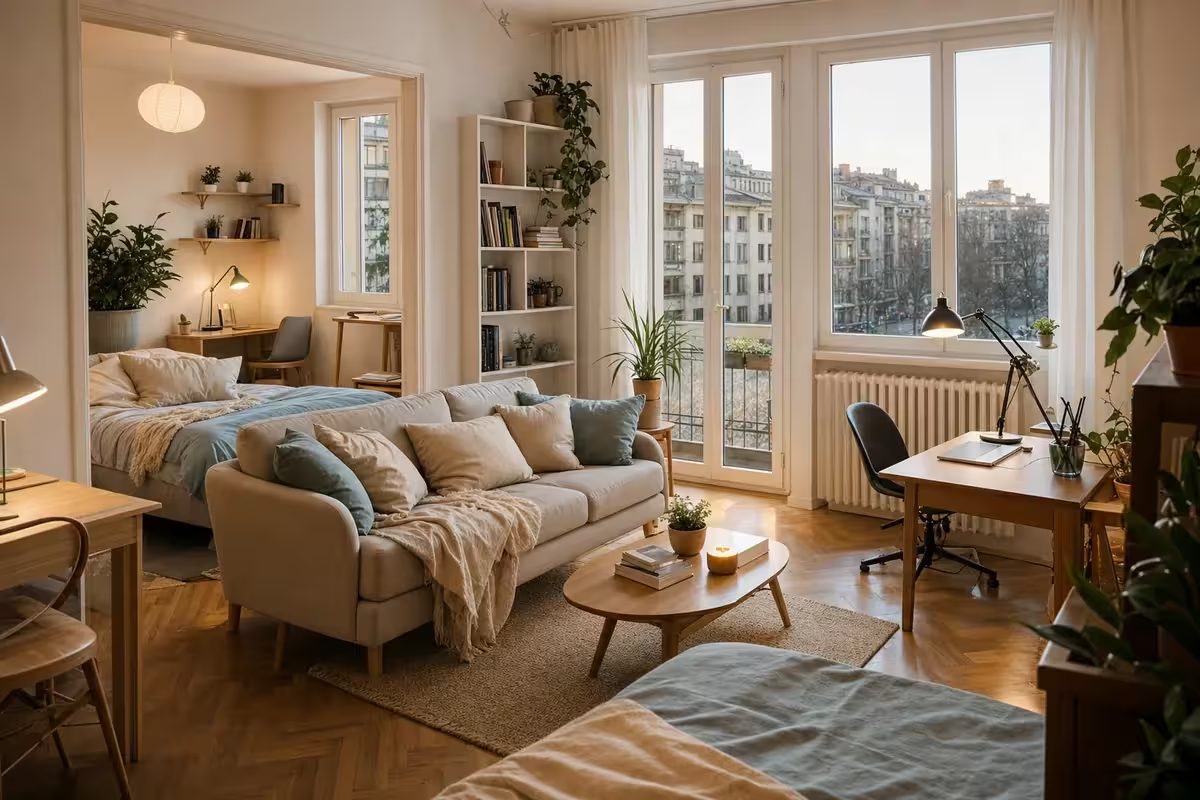
The dorm clearly remains the cheapest housing solution for students. For example, Academia de Studii Economice in București announced for the 2024-2025 academic year monthly fees of 270 lei for tuition-free students and 350 lei for fee-paying students.[3] Universitatea de Științe Agronomice și Medicină Veterinară in București also lists fees in the range of a few hundred lei per month, depending on the type of dorm and the student’s status.[4]
In other university centers, such as the “Tudor Vladimirescu” campus of Universitatea Tehnică „Gheorghe Asachi” in Iași, the fees for 2024-2025 are comparable, of a few hundred lei per month, with differences depending on comfort and room type.[5]
- Major advantage: the total accommodation cost can be even 5-6 times lower than a rented studio in București.
- Other advantages: proximity to the faculty, student community, utilities included or partially subsidized.
- Disadvantages: overcrowding (3-4 people in a room), strict rules, limited freedom in furnishing, noise and reduced privacy.
In addition, access to a dorm depends on grades, social situation and the limited number of places, and competition is strong every autumn, as emerges from university announcements regarding accommodation methods and tight deadlines for submitting applications.[5]
Classic rent in an apartment: maximum comfort, pressure on the budget
Renting an entire apartment or a studio remains the preferred option for total independence, but the pressure on the budget is major.
According to the 2024 Storia report, the national average for a studio reached 324 euros, and for a one-bedroom apartment 493 euros.[1] In București, data cited by Digi24 in July 2024 show an average of approximately 350 euros for a studio and 520 euros for a one-bedroom.[2] In university cities such as Iași, a Storia analysis taken over by HotNews indicated in the autumn of 2024 an average level of approximately 370 euros for a studio and 580 euros for a three-bedroom apartment.[6]
Without flatmates, these amounts fall entirely on a single person. On top of this come utilities (electricity, gas, water, internet), which can vary considerably depending on the season and the building’s energy efficiency. Even if inflation in utilities has cooled compared to the peak of previous years, Banca Națională and INS show that energy and gas prices remain sensitive, which makes it difficult to estimate them precisely in the long term.[7]
- Advantages: privacy, full control over the space, the possibility to work from home in peace, flexibility in choosing the area.
- Disadvantages: high monthly cost, full responsibility for contracts and the relationship with the landlord, higher risk in the event of tariff increases for utilities.
For a young person at the beginning of their career or for a student without substantial financial support, paying full rent in the capital can mean half or even more of their monthly income.
Coliving and living with flatmates: balance between cost and social life
Sharing an apartment with one or more flatmates, either informally or through modern coliving formulas, has become the most commonly used compromise solution. Financially, the effect is immediate: if a one-bedroom apartment in București costs on average 520 euros per month, splitting it between two flatmates brings the basic cost to about 260 euros per person, before utilities.[2]
Nationally, a one-bedroom apartment at an average of 493 euros per month divided between two tenants means approximately 246.5 euros per person; for three people, a three-bedroom apartment in Iași, at 580 euros, comes to around 193 euros per person for rent.[1][6] Even after including utilities, the difference compared to living alone remains significant.
- Financial advantages: immediate reduction of costs, the possibility to access better areas or better-maintained apartments.
- Lifestyle advantages: mutual support (sharing chores, subscriptions, some common expenses), richer social life, sense of community.
- Risks and disadvantages: low compatibility between flatmates, unclear rules regarding cleaning or guests, income differences that can create tension around paying rent and utilities on time.
Organized coliving models, where several people rent rooms in an apartment or a house managed by an operator, are also starting to appear on the local market. The advantage is that many costs are included and the rules are clear from the beginning, but prices can be slightly higher than in a direct arrangement with the landlord.
How to choose between dorm, rent and coliving, depending on your profile
The right decision depends on three factors: budget, lifestyle and medium-term plans.
1. Student with a limited budget
With a total budget of 1500-2000 lei per month, the dorm is most often the only sustainable option in major university cities. The difference between 300-400 lei in a dorm and over 1500 lei equivalent in rent plus utilities can make the difference between being able to focus on your studies and being forced to work intensively in parallel just to cover housing costs.
2. Young employee at the beginning of their career
If your net income is modest but stable, coliving is a more balanced solution. You can choose an apartment close to the office or well connected to public transport and share costs with one or two flatmates. As your income grows, you can decide to stay in coliving to save for a down payment on a mortgage or move to individual rent for more privacy.
3. Professional with above-average income
In this income range, classic rent in an apartment rented alone, possibly in a better-positioned neighborhood, becomes justifiable. You gain time, peace and comfort in exchange for a greater financial effort. Coliving can remain interesting if you want to reduce costs in order to invest more in other financial goals.
Regardless of your profile, it is essential to consider not only the base rent but also hidden costs: security deposit, agency fees, possible minor repairs, public transport passes or a personal car, differences in utility prices between old and new buildings.
Conclusion: coliving, the flexible solution between extremes
The rental market in Romania has entered a phase in which the cost differences between dorm, coliving and classic rent are very clear. The dorm remains unbeatable on price, but with sacrifices in comfort and privacy; individual rent offers maximum autonomy, but with heavy pressure on the budget. Between the two, coliving with flatmates allows access to better areas and more comfortable housing without exceeding a reasonable budget.
Before signing any contract, calculate realistically how much you can allocate monthly for housing without completely blocking your budget for savings and unforeseen expenses. Often, the optimal answer is not an extreme option, but an intelligent compromise between cost, comfort and community.
Sources
- Agerpres – Piața chiriilor în 2024, conform Storia
- Digi24 – Chiriile au crescut în marile orașe din România
- ASE București – Anunț cazare și tarife cămin 2024-2025
- USAMV București – Informații cămine 2024-2025
- Universitatea Tehnică „Gheorghe Asachi" Iași – Tarife cămin 2024-2025
- BNR – Raport asupra inflației, date privind evoluția prețurilor și utilităților
Întrebări frecvente
Is it cheaper to stay in a dorm or in an apartment with flatmates?
In most university cities, the dorm remains the cheapest solution, with fees of a few hundred lei per month. An apartment shared with one or two flatmates can significantly reduce the cost compared to living alone, but you will usually still pay several times more than in a dorm.
How much of my monthly income should I allocate to rent?
The general recommendation is that housing expenses (rent + utilities) should not exceed 30-35% of net income. If the percentage climbs towards 40-50%, coliving or a dorm become financially safer options.
What can I do if I have a small budget but do not get a place in a dorm?
Look for flatmates through verified groups, student forums and direct recommendations. Share an apartment with 2-3 people, negotiate the rent and try to avoid very expensive areas. It is important to have a clear contract and rules discussed from the beginning.