

Building permits are falling, transactions are holding up: a two speed market
In the first five months of 2026, 12,979 building permits for residential buildings were issued nationwide, 8.2% fewer than in the same period of 2025, according to INS data presented by Agerpres and also picked up by several specialist publications.(agerpres.ro) In May, 2,882 permits were issued, slightly above April, but below the level of May 2025, confirming the cooling trend on the side of future supply.(dcbusiness.ro)
On the other hand, ANCPI data show that real estate transactions are still holding at a high level. In May 2026, 50,314 real estate transactions were registered nationwide, up from April, when 48,135 properties were sold.(propwatch.ro) This combination, still active demand and retreating new supply, can change the balance of power between buyers, tenants and developers in the coming years.
An 8.2% decrease in building permits in January May 2026, but over 50,000 real estate transactions recorded in May 2026 alone, a mix that signals a more strained market in the medium term, especially in large cities.
Where construction sites are cooling: dynamics by region and city
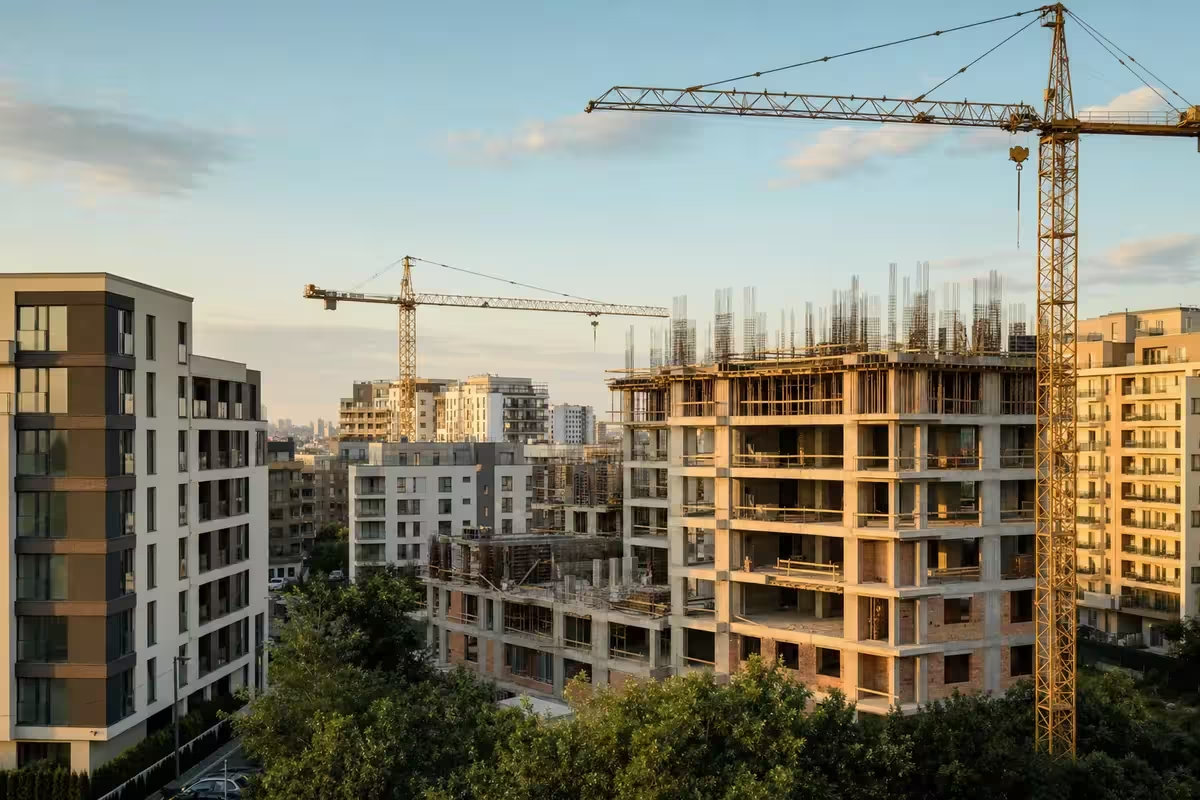
INS statistics indicate declines in permits in several development regions, especially in areas with intense residential activity in recent years. Specialist publications that have analysed the INS data note that the decline is not uniform but concentrated in certain regions, which may lead to a two speed market: cities that continue to attract projects and cities where developers are hitting the brakes.(atlantica.ro)
In parallel, on the transactions side, sources that process ANCPI data monthly show that in 2026 clear differences are emerging between the major regional centres. For example, independent analyses based on ANCPI statistics show that in May and June 2026, București and the Ilfov area recorded significant increases in the number of transactions compared with 2025, while counties such as Brașov or Iași recorded major decreases.(reddit.com)
The conclusion for buyers and investors is that we can no longer talk about a homogeneous “national market”. In București Ilfov, the pressure on future stock could be much higher than in counties where there are already projects underway and demand is showing signs of fatigue.
Detached houses versus apartment blocks: how supply is being redistributed
The breakdown by type of residential building is essential to understand the impact on neighbourhoods and prices. INS data show that, traditionally, an important share of permits is issued for individual dwellings in rural and peri urban areas, while large cities predominantly generate permits for apartment blocks.(agendaconstructiilor.ro)
The overall 8.2% decrease does not hit all segments in the same way. From our analysis of INS releases and market commentary, several trends are emerging:
- in peri urban areas of large cities, permits for detached houses and duplexes are slowing, against a backdrop of higher financing costs and more expensive utilities;
- in large cities, many apartment block projects are continuing, but developers are more cautious with new phases, which means fewer launches and stricter selection of land and concepts;
- in medium and small towns, where local demand is limited, some developers are postponing new projects until the appetite for buying at the new price and interest rate levels becomes clearer.
In the absence of a wave of permits for large apartment block projects, the new apartment segment in large cities could feel the pressure most quickly over a horizon of 2 3 years, when current construction sites will be completed.
What BNR says and how it shows up in prices
The financial stability report published by BNR in June 2026 underlines that risks to the financial system remain high, including from the real estate market, in a context of internal imbalances and external uncertainties.(agerpres.ro) Although the report does not point to an obvious real estate bubble, the central bank notes that the evolution of the housing market needs to be closely monitored, given the large share of mortgage loans on banks’ balance sheets.
A previous BNR report showed that up to 2024, prices for new housing in București remained below the level of other capitals in the region, even though the trend was upwards.(bnr.ro) In 2026, against the backdrop of falling permits and a high volume of transactions reported by ANCPI, the pressure on prices for well located projects is more likely to be upward, or at least for prices to be maintained, rather than a sharp correction.
What is important for buyers to understand is that a fall in permits does not automatically mean a fall in prices. In fact, when demand remains active and new supply decreases, the balance tends to favour sellers, especially in:
- neighbourhoods with good infrastructure and access to the metro or rapid transport;
- projects with high energy efficiency, where maintenance costs matter more and more;
- the middle and upper middle segment, where buyers with stable incomes have easier access to financing.
What it means for you as a buyer, tenant or investor
From the combination of INS permits in decline and ANCPI transactions still high, several clear messages emerge for those active in the market:
- Buyers of new homes: if you are targeting a good project in București or in large cities, the negotiation window in the medium term could be shorter than it seems. As current projects are completed, new phases will probably come with higher prices, influenced by construction and financing costs. Monitor delivery deadlines and the legal status of the project closely.
- Buyers of older homes: the segment of older apartments may become more dynamic as some buyers move from new to old in search of a more affordable price. The price difference between new and old in comparable areas could narrow.
- Tenants: in the short term, the impact of falling permits on rents is limited. In 2 3 years, however, a lower level of new stock in large cities may mean upward pressure on rents in central and semi central areas, especially if the economy avoids a severe recession.
- Investors: for those buying to rent out, the current period calls for very careful selection of projects and cities. Areas where transactions are increasing but permits are falling may offer, in the medium term, a better ratio between purchase price and potential rent.
At the same time, BNR’s message about high risks to financial stability is a reminder not to rely on the idea that prices “can only go up”. Keep a financial buffer, do not over indebt yourself and test prudent interest rate and income scenarios before signing any mortgage loan.(agerpres.ro)
Sources
- Agerpres INS, autorizatii de construire clădiri rezidențiale, ianuarie mai 2026
- Agenda Construcțiilor INS, autorizații de construire pentru locuințe, mai 2026
- DCBusiness analiză INS, scădere autorizații locuințe 2026
- PropWatch statistici ANCPI tranzacții imobiliare mai 2026
- ANCPI Comunicat tranzacții imobiliare aprilie 2026
- BNR Raport asupra stabilității financiare, iunie 2024, secțiunea piața imobiliară rezidențială
- Agerpres BNR, Raport asupra stabilității financiare, iunie 2026
- r/Imobiliare analiză evoluție tranzacții ANCPI mai 2026 pe județe
- r/Imobiliare analiză evoluție tranzacții ANCPI iunie 2026 București Ilfov vs alte județe
- r/Imobiliare extras și comentarii Raport BNR privind piața imobiliară
Întrebări frecvente
Cum mă afectează scăderea autorizațiilor dacă vreau să cumpăr în 2026?
In the very short term, the available supply is determined by projects already under construction or completed, not by new permits. The 8.2% decrease in permits for January May 2026 will be felt mainly in 2–3 years’ time, when current construction sites will be completed. In large cities, this may mean less good stock and a reduced capacity to negotiate for buyers.
De ce cresc tranzacțiile dacă dezvoltatorii iau mai puține autorizații?
Permits measure future projects, transactions measure today’s sales. Many projects started in previous years are now coming onto the market for sale and delivery, and some buyers are rushing to secure still favourable VAT and financing conditions. That is why we can see transactions increasing and new permits decreasing at the same time.
Este acesta începutul unei scăderi de prețuri la apartamente?
Current data do not support a generalized price correction. INS reports declines in permits, while ANCPI shows transactions still at high levels, and BNR speaks of risks but not of a clear bubble. It is more likely that we will see a segmented market: weaker projects and areas may correct, while good projects in large cities may maintain or even increase prices, against the backdrop of lower new stock in the coming years.